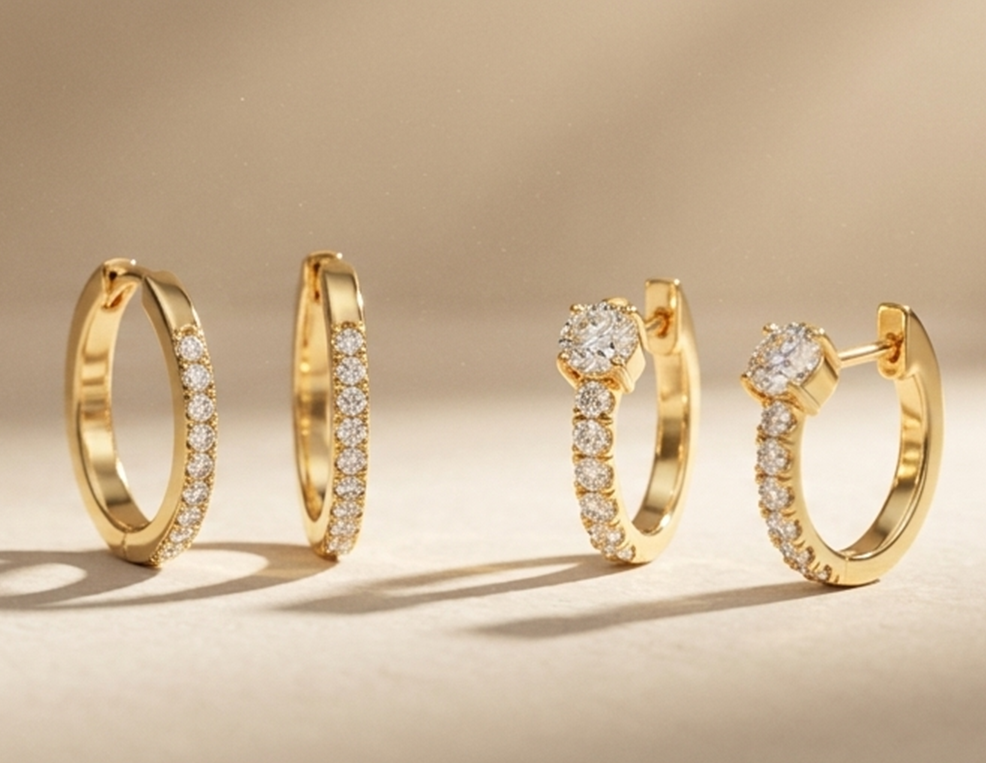
Diamond hoop earrings are one of the most enduring pieces in fine jewelry. They work for the office, a wedding, a weekend brunch, and every occasion in between. Unlike trend-driven statement earrings that date quickly, diamond hoops hold their relevance across decades — the design is simple enough to be timeless and elevated enough to always read as intentional. This guide covers everything you need to know before buying: what diamond hoop earrings are, the styles available, which metals to choose, what diamond types are used, and how to pick the right pair for your face shape, budget, and lifestyle.
What Are Diamond Hoop Earrings?
Diamond hoop earrings are circular or semi-circular earrings set with diamonds along part or all of the hoop's surface. The base structure is a hoop — a loop of metal that passes through the ear piercing and closes at the back — with diamonds added through a variety of setting styles to create sparkle and visual weight.
The result is an earring that combines the clean, architectural shape of a hoop with the brilliance of diamond. Diamond hoops range from tiny, earlobe-hugging huggies set with micro pavé diamonds to large, statement hoops featuring inside-out diamond coverage visible from every angle.
They're one of the most versatile diamond earring styles available, suitable for daily wear through to black-tie occasions depending on size and design.
A Brief History of Hoop Earrings
Hoop earrings are among the oldest forms of jewelry in human history. Archaeological evidence dates them back over 4,000 years to ancient Mesopotamia and Egypt, where gold hoops were worn by both men and women as symbols of status and wealth. Ancient Nubian, Greek, and Roman cultures all adopted hoop earrings, and they remained a consistent presence across global jewelry traditions through the medieval period and into the Renaissance.
Diamond-set hoops are a more modern development, becoming widely available as diamond cutting technology advanced through the 19th and 20th centuries. By the mid-20th century, diamond hoop earrings had become a staple of fine jewelry, worn by style icons and celebrities and eventually making their way from red carpets into everyday wardrobes.
Today, diamond hoop earrings are one of the top-selling fine jewelry categories globally — a position they've held for decades with no sign of fading.
Types of Diamond Hoop Earrings
Diamond hoops come in several distinct styles, each with a different look, scale, and occasion fit.
Huggie Diamond Earrings
Huggies are the smallest category of diamond hoop earrings. The name comes from the way they sit — flush against the earlobe with minimal gap between the metal and the skin. They typically measure between 10mm and 15mm in diameter and feature a hinged closure for easy on and off.
Despite their small scale, huggie diamond earrings pack a strong visual impact because their smaller circumference concentrates the diamonds more densely, creating a richer, more saturated sparkle than a larger hoop with the same total carat weight. Pavé and channel-set huggies are the most common configurations.
Huggies are the ideal everyday diamond hoop. They're lightweight, low-profile enough to avoid snagging on hair or clothing, and versatile enough to wear from Monday meetings through weekend occasions. They also work exceptionally well as a second or third piercing, layered alongside larger hoops or studs.
Classic Diamond Hoop Earrings
The classic diamond hoop is the most widely recognized style — a full circular hoop set with diamonds along the front-facing portion of the band. Diamonds typically cover the outer half of the hoop (the portion visible from the front), while the back section remains plain metal.
Classic diamond hoops range from small (16mm–20mm) through to large statement sizes (40mm+). The front-set diamond configuration keeps the earring lightweight relative to its visual impact, since the back section requires no stones. This style suits a wide range of face shapes and hair lengths and transitions naturally between casual and formal dressing.
Inside-Out Diamond Hoop Earrings
Inside-out diamond hoop earrings feature diamonds set on both the outer and inner surfaces of the hoop band. This means the diamonds catch light from every angle — whether the earring is viewed from the front, side, or in motion. The result is dramatically more sparkle and brilliance than a front-set hoop, making inside-out diamond hoops one of the most visually striking configurations available.
The trade-off is weight. With diamonds set across the full circumference of both surfaces, inside-out hoops are heavier than equivalent single-surface styles. They're best worn for occasions rather than daily use, particularly in larger carat weights.
Pavé Diamond Hoop Earrings
Pavé diamond hoop earrings are set with rows of tiny diamonds packed closely together across the hoop's surface, held in place by minimal metal prongs or beads. The term "pavé" comes from the French word for paved — the setting style resembles a cobblestone surface where the diamonds are the stones.
Pavé diamond hoops create a continuous, shimmering surface with no visible breaks between stones. The effect is one of total diamond coverage, even when the individual stones are very small. Micro pavé — an even finer version using smaller stones — is increasingly popular in huggie and small hoop styles.
Pavé settings require more maintenance than channel or prong settings because the small prongs holding each stone can loosen with wear. Periodic professional inspection is recommended for pavé diamond hoops worn regularly.
Channel Set Diamond Hoop Earrings
In a channel setting, diamonds are set between two parallel rails of metal with no prongs separating the stones. The diamonds sit edge-to-edge in a clean, flush row, creating a smooth, streamlined look with a modern, architectural finish.
Channel set diamond hoop earrings are more secure than pavé settings — the metal channel walls protect the diamonds from impact — and they're well-suited for daily wear. The absence of prongs means a cleaner side profile and less risk of the earring catching on fabric or hair.
Prong Set Diamond Hoop Earrings
In prong set diamond hoop earrings, each diamond is held individually by small metal claws (typically three, four, or six prongs per stone). This setting style maximizes the diamond's exposure to light, allowing brilliance to be viewed from multiple angles and making each individual stone more visible.
Prong set hoops work well with round brilliant and princess cut diamonds, which benefit from maximum light exposure. The setting creates a more traditional, classic aesthetic compared to the sleeker look of channel or pavé.
U-Prong Diamond Hoop Earrings
U-prong settings feature U-shaped prongs that cradle each diamond from the sides rather than the top. This exposes more of each stone's table facet and allows light to enter from a wider angle, resulting in stronger brilliance. When viewed from the side, U-prong diamond hoops show a distinctive scalloped edge that adds visual detail and craftsmanship.
Diamond Hoop Earring Sizes
Hoop earring size is measured by the internal diameter of the hoop — the distance across the inside of the circle.
Size
Diameter
Best For
Mini / Huggie
10mm – 15mm
Daily wear, second piercings, layering
Small
16mm – 20mm
Office, understated everyday wear
Medium
21mm – 35mm
Versatile — casual through smart casual
Large
36mm – 50mm
Evening, statement occasions
Oversized
50mm+
Bold fashion styling, special events
A helpful reference point: a US dime is approximately 18mm across, and a US quarter is approximately 24mm. Visualizing your hoop against these coins gives a quick sense of scale before buying.
Larger hoops are heavier, which is worth factoring into your decision if you have sensitive earlobes or plan to wear the earrings for extended periods.
Metals for Diamond Hoop Earrings
The metal you choose for diamond hoop earrings affects the overall aesthetic, durability, maintenance requirements, and price.
White Gold Diamond Hoop Earrings
White gold is the most popular metal choice for diamond hoop earrings. Its cool, silver-toned finish lets the diamonds take center stage without the metal competing for visual attention. White gold diamond hoop earrings read as clean, modern, and versatile — they work with both warm and cool skin tones and coordinate naturally with platinum and silver jewelry.
White gold is an alloy — typically 75% pure gold mixed with palladium, silver, or nickel, then plated with rhodium for its bright white finish. The rhodium plating requires periodic replating (every one to two years with regular wear) to maintain its color.
Yellow Gold Diamond Hoop Earrings
Yellow gold is the traditional metal for hoop earrings and carries a warmth and richness that white gold doesn't replicate. Diamond hoop earrings in yellow gold — particularly 14k or 18k — pair beautifully with warm and olive skin tones and complement both classic and contemporary jewelry stacks.
14k yellow gold (58.5% pure gold) is the most practical choice for everyday diamond hoop earrings — harder and more scratch-resistant than 18k, and significantly more durable than 24k. 18k yellow gold (75% pure gold) has a richer, deeper color and is ideal for special-occasion pieces.
Rose Gold Diamond Hoop Earrings
Rose gold's warm pink tone has become one of the most popular metal choices in fine jewelry over the past decade. Diamond hoop earrings in rose gold have a distinctly romantic, contemporary aesthetic that suits a wide range of skin tones, particularly fair to medium complexions.
Rose gold gets its color from copper — typically a 14k or 18k gold alloy with a higher copper content than yellow gold. The copper also makes rose gold slightly harder and more durable than yellow or white gold at equivalent karat weights.
Platinum Diamond Hoop Earrings
Platinum is the most premium metal for diamond hoop earrings. It's naturally white (no rhodium plating required), denser and heavier than gold, and extremely durable. Platinum's security for stone settings is unmatched — the metal's density means prongs and settings are more resistant to deformation over time.
Platinum diamond hoops are the best choice for high-value, heirloom-quality pieces or inside-out hoops with significant diamond coverage. The premium price point — platinum typically costs 40–60% more than equivalent white gold — reflects both the metal's rarity and its longevity.
Diamond Types Used in Hoop Earrings
Round Brilliant Diamonds
Round brilliant cut diamonds are the most common diamond type in hoop earrings, and for good reason. The round brilliant's 57 or 58 facets are engineered to maximize light return and sparkle — it's the most brilliant diamond cut available. In hoop earrings, where individual diamonds may be small, the round brilliant's superior light performance ensures each stone catches and reflects light effectively even at small carat weights.
Princess Cut Diamonds
Princess cut diamonds - square-shaped with pointed corners - are the second most common diamond type in hoop earrings. Their angular shape creates a modern, geometric look that contrasts the hoop's circular silhouette. Princess cuts sit naturally in channel settings due to their straight edges and deliver strong brilliance second only to round brilliants among diamond shapes.
Baguette Diamonds
Baguette diamonds are long, rectangular step-cut stones with clean, parallel facets. In hoop earrings, baguettes create a sleek, architectural look very different from the sparkle of brilliant-cut stones. The step-cut faceting produces long, linear light flashes rather than scattered brilliance, resulting in a more understated, sophisticated aesthetic.
Baguette diamond hoop earrings are a strong choice for buyers who prefer a refined, less flashy look — more editorial than bridal.
Lab Grown Diamonds
Lab grown diamonds are chemically, physically, and optically identical to mined diamonds. They're produced in controlled laboratory environments using HPHT (High Pressure High Temperature) or CVD (Chemical Vapor Deposition) processes that replicate natural diamond formation.
For hoop earrings — which often contain multiple small stones — lab grown diamonds offer a meaningful price advantage. A pair of pavé or inside-out diamond hoop earrings set with lab grown diamonds typically costs 50–70% less than an equivalent pair set with natural diamonds of the same grade, with no difference in appearance or performance.
GIA and IGI both certify lab grown diamonds to the same 4C standards applied to natural diamonds.
How to Choose the Right Diamond Hoop Earrings
By Face Shape
Round face: Medium to large hoops with a longer drop create a lengthening effect. Avoid very wide, chunky hoops that emphasize width.
Oval face: The most versatile face shape. Almost all hoop sizes and styles work well.
Square face: Large, rounded hoops soften a strong jawline. Avoid angular or geometric shapes.
Heart face: Medium hoops balanced in width work well. Avoid very large hoops that amplify a wider forehead.
Long face: Medium to large hoops add width and balance. Avoid very long, dangling hoop styles that further elongate the face.
By Occasion
Daily wear: Huggie hoops or small classic hoops in 14k gold, pavé or channel set
Office: Small to medium hoops in white or yellow gold, kept refined and close to the ear
Evening and events: Medium to large hoops, inside-out diamond coverage, or statement carat weights
Bridal: Inside-out diamond hoops or pavé huggies in white gold or platinum
By Diamond Quality
For hoop earrings with multiple small stones, prioritize cut and color over clarity. The brilliance of each stone matters more than its clarity grade in a multi-stone setting — an SI1 round brilliant will sparkle strongly and appear eye-clean. For color, G-H is the practical sweet spot — near-colorless, well-priced, and visually indistinguishable from D-F in a hoop setting.
Caring for Diamond Hoop Earrings
Clean with warm water, mild dish soap, and a soft-bristled brush every two to four weeks
Remove before swimming, showering, or exercising — chlorine and saltwater accelerate metal wear
Store in a fabric-lined jewelry box or separate pouch to prevent scratching
Have settings inspected professionally once a year, particularly for pavé and prong-set styles
Replating white gold rhodium coating every one to two years maintains the bright white finish
Final Thoughts
Diamond hoop earrings are one of the most versatile investments in fine jewelry. The right pair works across virtually every occasion - from the office to a formal event -and holds its style relevance indefinitely. Choosing the right pair comes down to size, setting style, metal, and diamond type, all of which this guide covers in full.
At Fascinating Diamonds, we carry a curated selection of GIA and IGI certified diamond hoop earrings across every major style - huggie, classic, inside-out, pavé, and channel set — in white gold, yellow gold, rose gold, and platinum. Browse our diamond hoop earring collection to find the style and size that fits your look, your lifestyle, and your budget.
Diamond hoop earrings are circular or semi-circular earrings featuring diamonds set along part or all of the hoop's surface. They combine the timeless shape of a hoop earring with the brilliance of diamonds, available in styles ranging from tiny huggie hoops to large inside-out statement pieces.
2. What is the difference between huggie earrings and hoop earrings?
✚
Huggie earrings are a subcategory of hoop earrings. They're distinguished by their small diameter (10mm–15mm) and the way they sit flush against the earlobe. Standard hoop earrings are larger in diameter and hang below the earlobe. Both can be set with diamonds.
3. What metal is best for diamond hoop earrings?
✚
White gold is the most popular choice — its neutral tone lets the diamonds take center stage and it suits most skin tones. Yellow gold is the traditional choice with a warmer, richer aesthetic. Rose gold offers a contemporary, romantic look. Platinum is the most durable and premium option, ideal for high-value pieces.
4. What is an inside-out diamond hoop earring?
✚
Inside-out diamond hoop earrings feature diamonds set on both the inner and outer surfaces of the hoop. This means the diamonds catch light from every angle, creating maximum brilliance and visibility compared to front-set or outer-surface-only styles.
5. What diamond cut is best for hoop earrings?
✚
Round brilliant cut diamonds are the best choice for maximum sparkle in hoop earrings. Their faceting is engineered specifically to maximize light return, which is especially important in hoop settings where individual stones are often small. Princess cut and baguette diamonds are popular alternatives for different aesthetic effects.
6. Are lab grown diamonds good for diamond hoop earrings?
✚
Yes. Lab grown diamonds are physically and optically identical to natural diamonds and are graded to the same standards. For hoop earrings — which often contain many small stones — lab grown diamonds offer the same visual quality at a significantly lower price point, typically 50–70% less than natural diamond equivalents.
7. What size diamond hoop earrings should I buy?
✚
It depends on your face shape, hair length, and occasion. Huggie to small hoops (10mm–20mm) are best for daily and professional wear. Medium hoops (21mm–35mm) are the most versatile for casual through smart-casual occasions. Large hoops (36mm+) make the strongest statement and work best for evening events or when wearing hair up.
8. How do I clean diamond hoop earrings at home?
✚
Soak in warm water with a few drops of mild dish soap for 15–20 minutes, then gently scrub with a soft toothbrush to remove buildup from around the settings. Rinse thoroughly with clean water and pat dry with a lint-free cloth. Avoid ultrasonic cleaners for pavé-set hoops, as vibration can loosen small stones.
9. Are diamond hoop earrings suitable for everyday wear?
✚
Yes, particularly huggie and small classic hoop styles in 14k gold. These are durable, low-profile enough to avoid snagging, and weighted appropriately for extended wear. Larger, heavier styles with significant diamond coverage are better reserved for occasional wear.