

Heart Shaped Engagement Rings
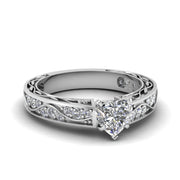
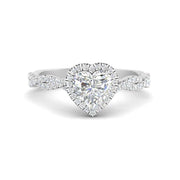
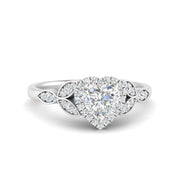
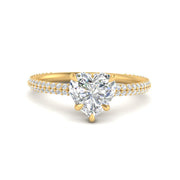
Heart shaped diamond engagement rings are one of the most expressive choices in fine jewelry, combining a deeply personal silhouette with strong brilliance and excellent finger coverage. The heart shape is a modified brilliant cut with 56 to 58 facets, producing fire and sparkle comparable to a round diamond when cut to ideal proportions. Fascinating Diamonds offers 100+ heart shaped engagement rings in natural and lab grown diamonds, available in solitaire, halo, hidden halo, and three-stone settings.
Explore Our Heart Shaped Engagement Rings Collection











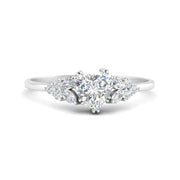


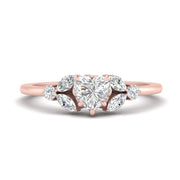


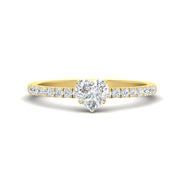


Why Customers Love Fascinating Diamonds
-
Kate C.
PERFECT!!! My asscher earrings are
PERFECT!!! My asscher earrings are 2ct total and yellow gold bezel. Stones are beautifully matched and certified and they are gorgeous on. Radiantly clear and almost architectural, I love everything about them. Price was right and the service was superb. Thank you Raj for the beautiful earrings and such

-
Doak A.
Beautiful. Different look and perfect size
Thank you for the excellent work
-
Lubomir Asenov
Very professional and attentive. Raj took care of everything very well, I’ll definitely buy from Fascinating Diamonds again.

-
Denise
Incredible Customer Service
So I had a lot of questions and Raj was so great to message me all the way through. Even checked back in and called to make sure I was completely satisfied! Amazing customer service truly. And we love our rings!!

-
Kevin Mcknight
I received the very best customer service ever!!!! Raj was absolutely awesome. The diamond ring we purchased is beautiful and very well made. I will be a return client for many years and occasions. Just the best retail experience online!!!!
-
Cynthia
My piece was amazing
My piece was amazing! Simply beautiful diamond ring.
-
Tim Calandrello
I was extremely happy with my entire experience and the jewelry is gorgeous. There was also really great communication with the company when I had questions. They were professional, responsive and a pleasure to deal with. The item arrived exactly when they said it would and I couldn't be happier. I'll absolutely order from them again.
-
Bri
Beautiful, Excellent Communication
Excellent, quick, effective communication. The ring I picked out came out even more beautiful than I expected.
-
Kevin M.
As always, Raj has given perfect
As always,Raj has given perfect product and service. I'm a customer for life
-
Caroline Wooldridge
Raj was very communicative, empathetic and proactive in trying to help me with my mother's birthday gift. Would recommend! FYI, Im not a big jewelry buyer so was unfamiliar with these kind of stores/offices, but it's like a small office on high floor. He has a variety of samples/examples there, but most are ordered / custom (vs a full retail store.)
-
Linda Courtney
The ring I received is lovely
The ring I received is lovely! There was an error to my order and they adjusted the difference promptly to my account. I would highly recommend this company!
-
Cynthia T.
Will definitely buy from again.
Will definitely buy from again. Beautiful product, great communication, secure shipping.
-
Kevin Mcknight
I received the very best customer service ever!!!! Raj was absolutely awesome. The diamond ring we purchased is beautiful and very well made. I will be a return client for many years and occasions. Just the best retail experience online!!!!
-
FB
Great Purchase
Beautiful earrings and setting. Kind people that are always willing to answer questions.
-
Mirander
good
remarkable pendant with exquisite design. I am in love....thank you


Heart Shaped Diamond Engagement Rings: The Complete Guide
Heart shaped diamonds have a longer history in fine jewelry than most people realize. The shape dates to the 16th century, with some of the earliest recorded heart shaped diamonds exchanged between European royalty as symbols of devotion. Today, the heart shaped diamond occupies a distinct position in the engagement ring market — it's neither a classic choice nor a purely fashion-driven one. It's a deliberate, personal statement, chosen by buyers who want their ring to mean something specific.
When cut correctly, a heart shaped diamond produces brilliance and fire that rivals a round brilliant. The challenge is that the heart shape is one of the most technically demanding cuts to execute well. Small inconsistencies in the lobes, cleft, or point become immediately visible to the eye in a way that less defined shapes can hide. This is why cut quality and symmetry matter more for heart shaped diamonds than for almost any other shape.
What to Look for in a Heart Shaped Diamond
The most important factor in choosing a heart shaped diamond is symmetry. The two lobes must be equal in size and curvature. The cleft — the inward V at the top of the heart — should be well-defined and centered. The point at the base should be sharp and centered directly below the cleft. Any deviation from this makes the heart shape look uneven or distorted, which undermines the entire appeal of the cut.
Beyond symmetry, the length-to-width ratio determines whether the heart looks full and rounded or narrow and elongated. A ratio between 0.90 and 1.05 produces the most balanced, recognizable heart shape. Ratios below 0.90 create a wide, squat heart that can look heavy. Ratios above 1.10 produce a narrow, elongated heart that loses the classic silhouette. Most buyers are happiest in the 0.95 to 1.00 range, which delivers a proportional heart with strong finger coverage.
Best Settings for Heart Shaped Engagement Rings
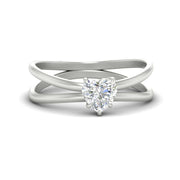
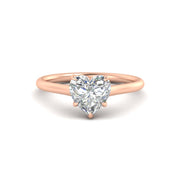
Solitaire Engagement Rings: A three-prong or five-prong solitaire is the most traditional setting for a heart shaped diamond. It exposes the maximum amount of the stone's surface, letting the heart silhouette read clearly from above. The critical requirement is a V-prong at the pointed tip — without it, the point is vulnerable to chipping. A solitaire setting is the right choice if the heart shape itself is the statement and you don't want anything competing with it.
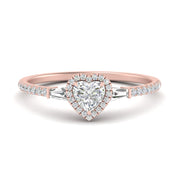
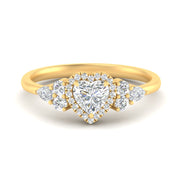
Halo Engagement Rings: A halo of round accent diamonds traces the heart's outline and does two things simultaneously: it increases the apparent size of the center stone and it reinforces the heart shape so it reads more clearly at a distance. This is the most popular setting style for heart shaped engagement rings because it solves one of the cut's inherent challenges — the heart silhouette can be subtle in a plain solitaire setting but becomes unmistakable with a halo frame.
Hidden halo Engagement Rings: A hidden halo places accent diamonds on the underside of the center stone, beneath the girdle. From directly above, the ring looks like a clean solitaire. From the side or at an angle, additional diamonds are visible, adding brightness without changing the top-down profile. This is a good choice for buyers who want the size-enhancing effect of a halo with a more minimalist aesthetic.
Three-stone Engagement Rings: Flanking a heart shaped center stone with two matching hearts or two tapered baguettes creates strong symmetry and adds meaningful carat weight. Three-stone heart engagement rings carry traditional symbolism — past, present, and future — which layers additional meaning onto an already expressive center shape.
Heart Shaped Diamond Durability and Daily Wear
The pointed tip at the base of a heart shaped diamond is the most vulnerable part of the stone and the main durability consideration for everyday wear. Diamond is the hardest natural material, but sharp points and thin edges can chip if struck at the right angle with enough force. The solution is a well-designed V-prong that cups and protects the point without covering so much of the diamond that it obscures the silhouette.
The rounded lobes at the top of the heart are less vulnerable than the point and don't require special prong treatment, though secure four or six-prong settings are standard. With proper setting design and normal care, heart shaped engagement rings are entirely suitable for everyday wear.
Heart Shaped Diamond vs. Other Fancy Shapes
Heart vs. Pear: Both shapes have a pointed tip that requires a V-prong. The pear is asymmetrical by design while the heart demands perfect bilateral symmetry, making the heart cut more technically demanding to cut well. Pear cuts are more common and easier to find in high-symmetry grades. Heart cuts are rarer in well-cut form and carry stronger symbolic weight.
Heart vs. Round: A round brilliant maximizes light return through its symmetrical 57-facet arrangement. A heart shaped diamond produces comparable fire but slightly less overall brilliance because the irregular outline makes optical precision harder to achieve. Heart cuts cost 20 to 30 percent less per carat than round diamonds at equivalent quality grades, which makes them an efficient choice for buyers prioritizing carat size within budget.
Heart vs. Oval: Oval cuts elongate the finger and have no pointed tip vulnerability. Heart cuts make a stronger visual statement and carry more symbolic meaning but require more care in setting selection. Both are considered romantic, non-traditional choices, but the heart is the more expressive of the two.
Natural vs. Lab Grown Heart Shaped Engagement Rings
Heart shaped diamonds are available in both natural and lab grown options at Fascinating Diamonds. Natural heart shaped diamonds are GIA or IGI certified, carry the rarity associated with mined stones, and retain long-term collectible value. Lab grown heart shaped diamonds are chemically and optically identical to natural diamonds and typically cost 50 to 70 percent less per carat. Because heart shapes are sensitive to cut quality, lab grown options are worth considering specifically for this shape — the lower cost per carat allows you to prioritize a higher symmetry grade or a larger stone without stretching the budget.
Metal Options for Heart Shaped Engagement Rings
Platinum and white gold are the most popular metal choices for heart shaped rings. The neutral, cool tone creates a clean backdrop that lets the diamond's brilliance read at maximum intensity. White gold is more affordable than platinum; platinum is denser, more durable, and develops a natural patina over time.
Yellow gold pairs naturally with heart shaped diamonds in the G-J color range. The warm metal tone complements the cut's fire and creates a vintage-inspired look. Yellow gold heart shaped rings in halo settings are currently trending for their romantic, editorial quality.
Rose gold is a particularly strong pairing for heart shaped diamonds. The blush tone reinforces the romantic associations of the heart shape and works especially well with pavé and halo settings. Rose gold heart shaped engagement rings in 14K are among the most searched combinations in this category.
FAQs For Heart Shaped Engagement Rings
What does a heart shaped engagement ring symbolize?
A heart shaped engagement ring symbolizes love, emotional connection, and intentionality. The heart is one of the most universally recognized symbols of romantic love, and choosing it as a diamond shape signals a deliberate, personal statement rather than a conventional choice. It's most often chosen by buyers who want their ring to carry visible meaning beyond tradition.
Are heart shaped diamonds good for engagement rings?
Yes, when cut to ideal proportions and set with a V-prong at the tip. A well-cut heart shaped diamond produces brilliance and fire comparable to a round brilliant. The main consideration is cut quality — the heart silhouette depends entirely on symmetry, so a poorly cut heart shaped diamond looks uneven or loses its recognizable shape. Buying from a jeweler who provides certified stones and clear imaging is important with this shape.
What is the best ratio for a heart shaped diamond?
The ideal length-to-width ratio for a heart shaped diamond is between 0.90 and 1.05. This range produces a balanced, proportional heart with equal lobes and a well-defined cleft. Ratios below 0.90 create a wide, heavy-looking heart. Ratios above 1.10 produce a narrow, elongated shape that loses the classic heart silhouette. Most buyers find the 0.95 to 1.00 range to be the most universally flattering.
Do heart shaped engagement rings look bigger than round diamonds?
Heart shaped diamonds can appear larger than round diamonds of the same carat weight because the shape spreads mass across a wider surface area, including the two lobes and the point. A halo setting further increases the apparent size by framing the heart with accent diamonds. On average, a 1-carat heart shaped diamond has a slightly larger face-up area than a 1-carat round brilliant, making it an efficient choice for buyers prioritizing visual size.
Are lab grown heart shaped engagement rings worth it?
Yes, particularly for this shape. Because heart shaped diamonds are more sensitive to cut quality than other shapes, lab grown options are worth considering specifically because the lower cost per carat allows you to allocate more budget toward symmetry grade, color, and clarity rather than simply carat weight. Lab grown heart shaped diamonds are chemically and optically identical to natural diamonds and typically cost 50 to 70 percent less at equivalent quality grades.
What wedding bands pair best with heart shaped engagement rings?
Curved or contoured wedding bands are the most practical pairing for heart shaped engagement rings because the pointed base of the heart shape creates a gap against a straight band. A curved band is designed to nestle against the ring's profile, eliminating the gap and creating a flush, integrated look. Slim pavé or plain curved bands in matching metal work best. Straight bands can be worn but typically sit separately rather than flush against the engagement ring.