

Oval Cut Diamond Engagement Rings
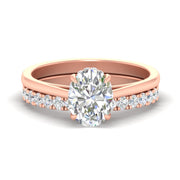
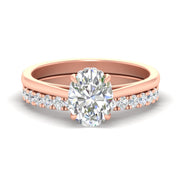
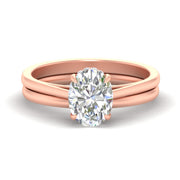
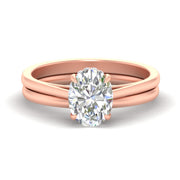
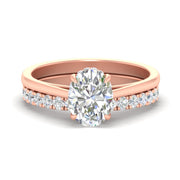
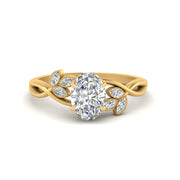
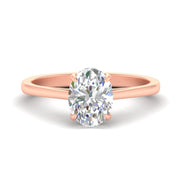
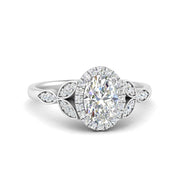
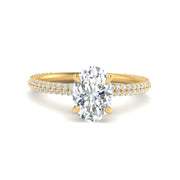
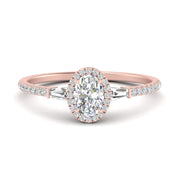
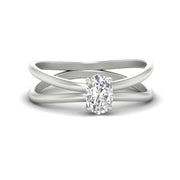
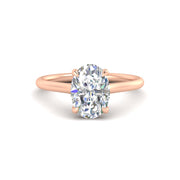
Oval cut diamond engagement rings combine the brilliance of a round diamond with an elongated silhouette that creates one of the largest face-up appearances of any diamond shape at the same carat weight. The oval cut has 56 to 58 facets arranged in a modified brilliant pattern, producing strong light return, visible fire, and exceptional finger coverage that makes the stone appear larger and the hand appear longer. Fascinating Diamonds offers 150+ oval cut engagement rings in natural and lab grown diamonds. Available in solitaire, halo, hidden halo, three-stone, and east-west settings in platinum, white gold, yellow gold, and rose gold.
Explore Our Oval Cut Engagement Rings Collection


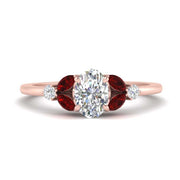


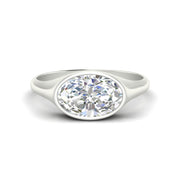


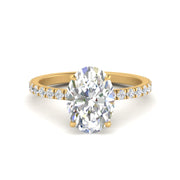

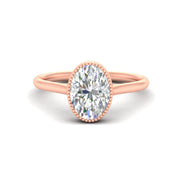














Real Customer Reviews
Oval Cut Diamond Engagement Rings: The Complete Guide
Oval cut diamonds are the most commercially successful fancy shape in the engagement ring market right now. They've been the fastest-growing diamond shape in the US for several consecutive years, consistently ranking second only to round brilliants in total sales volume. The reasons are practical as much as aesthetic: oval cuts offer round-diamond-level brilliance, stronger finger coverage per carat than rounds, a lower price per carat than rounds at equivalent quality grades, and a softer, less directional silhouette than other fancy shapes like marquise or pear. For a buyer who wants something that isn't round brilliant without committing to a more polarizing shape, the oval is the most versatile answer available. Before selecting a stone, read 4 things you need to know before buying oval cut diamonds for a complete pre-purchase checklist.
The cut itself dates to the early 1960s, when Russian diamond cutter Lazare Kaplan developed the modern oval brilliant as a way to salvage elongated rough diamonds while maximizing carat retention and light performance. The resulting shape retained the fire and brightness of a round brilliant while creating a distinctly different, elongated outline. That origin — a cut engineered for both beauty and efficiency — explains why oval diamonds continue to outperform other fancy shapes in value terms.
Oval Diamond Proportions: Length-to-Width Ratio
The length-to-width ratio determines the overall shape of an oval diamond — how elongated or full it appears from above. The standard recommended range is 1.35 to 1.50, and choosing the right ratio is one of the most effective ways to avoid the bow-tie effect in oval diamonds. Within that range, a ratio around 1.35 to 1.40 produces a wider, rounder oval with a full, substantial silhouette. A ratio around 1.45 to 1.50 produces a more elongated, narrow oval with a stronger finger-lengthening effect. Both ends of the range are valid choices — the right ratio depends entirely on hand proportions and personal preference.
Ratios below 1.35 start to look nearly round and lose the defining characteristic of the oval shape. Ratios above 1.50 begin to look narrow and elongated in a way that makes the bow-tie effect more visible. Most buyers land happiest in the 1.40 to 1.50 range, which balances finger coverage with a clearly oval silhouette.
For fingers that are shorter or wider, a ratio closer to 1.45 to 1.50 maximizes the lengthening effect. For longer, more slender fingers, a fuller ratio around 1.35 to 1.40 fills the finger proportionally without looking too narrow.
The Bow-Tie Effect in Oval Cut Diamonds
The bow-tie effect is a dark shadow that appears across the center of oval diamonds, running horizontally through the stone's widest point. It's caused by light that enters the diamond through the upper facets but exits through the bottom of the stone rather than reflecting back to the eye. The result is a dark band that visually interrupts the diamond's brilliance at the center.
Some degree of bow-tie is present in nearly all oval cut diamonds. The important distinction is between a faint bow-tie, which is normal and barely visible in motion, and a strong, dark bow-tie, which is a cut quality problem that significantly reduces the stone's light performance and visual appeal. A faint bow-tie is acceptable and often undetectable once the ring is on the finger and moving. A severe bow-tie should be avoided entirely.
Bow-tie severity doesn't appear anywhere on a GIA or IGI grading report, which is why understanding how ratio affects the bow-tie effect matters before selecting a stone. When evaluating oval cut diamonds at Fascinating Diamonds, always request stone-specific video so you can assess the bow-tie before committing to a purchase.
Oval Cut vs. Other Diamond Shapes
Oval vs. Round: Round brilliant diamonds produce maximum light return through their perfectly symmetrical 57-facet arrangement. Oval cuts produce comparable brilliance but with a larger face-up surface area and a finger-lengthening silhouette. Oval diamonds typically cost 15 to 20 percent less per carat than round diamonds at equivalent quality grades. For buyers who want round-level sparkle with more visual presence, oval is the most direct upgrade.
Oval vs. Cushion: Cushion cuts diamonds have a squarish or rectangular outline with rounded corners and produce more fire than ovals, but less finger coverage. Oval cuts have a stronger elongating effect on the finger and appear larger face-up than cushion cuts at the same carat weight. Cushions have a warmer, more vintage character. Ovals are more contemporary and versatile across setting styles.
Oval vs. Pear: Both shapes are elongated and elongate the finger, but pear cuts taper to a point at one end and require a V-prong for protection. Oval cuts have fully rounded ends, no pointed tip vulnerability, and are more symmetrical. Ovals are easier to set, more durable at the edges, and currently more popular. Pear cuts carry a more distinctive, fashion-forward aesthetic for buyers who want something less common than an oval.
Oval vs. Marquise: Marquise cuts have pointed tips at both ends and produce the largest face-up appearance of any diamond shape. Oval cuts have fully rounded ends, no tip vulnerability, and a softer silhouette. Marquise cuts are more dramatic and angular. Ovals are more approachable and versatile. Both elongate the finger effectively.
Best Settings for Oval Cut Engagement Rings
Solitaire Engagement Rings: A four or six-prong solitaire is the most classic setting for an oval cut diamond. The prongs should be positioned to secure the stone without covering the diamond's widest points, which would interrupt the clean oval outline. A thin, plain band is the best complement, keeping all visual weight on the center stone. A solitaire setting is the right choice when the oval diamond itself is the statement.
Halo Engagement Rings: A halo of round accent diamonds traces the oval's outline and amplifies its apparent size significantly. A well-designed oval halo can make a 1-carat center stone appear close to 1.5 carats. The halo also reinforces the oval shape, making the silhouette read more clearly at a distance and from a seated position. Oval halo rings are consistently one of the top-selling styles in this shape category.
Hidden halo Engagement Rings: A hidden halo places accent diamonds on the underside of the bezel, beneath the girdle of the center stone. From directly above, the ring presents as a clean solitaire. From the side or at an angle, the additional diamonds add brightness and visual depth. This setting is ideal for buyers who want extra sparkle with a minimalist top profile. See our full guide to hidden halo oval engagement rings for a detailed breakdown of how the setting works and what to look for.
Three-stone Engagement Rings: Flanking an oval center stone with two smaller matching ovals or tapered baguettes creates strong visual balance and adds meaningful carat weight to the overall ring. Three-stone oval rings carry the traditional symbolism of past, present, and future, which pairs naturally with the oval cut's romantic, timeless character.
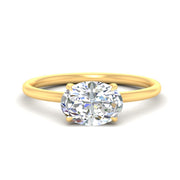
East-west Engagement Rings: An east-west setting rotates the oval 90 degrees so its length runs horizontally across the finger rather than vertically along it. This modern orientation emphasizes finger width rather than length and creates a distinctive, architectural look that reads as fashion-forward without being unconventional. East-west oval rings in yellow gold are currently one of the strongest trending styles in the non-traditional engagement ring market.
Natural vs. Lab Grown Oval Cut Engagement Rings
Fascinating Diamonds offers oval cut engagement rings in both natural and lab grown diamonds across all carat weights, settings, and metal types. Natural oval diamonds are GIA or IGI certified, carry the rarity associated with mined stones, and are the standard choice for buyers who prioritize provenance and long-term collectible value. Lab grown oval diamonds are chemically, physically, and optically identical to natural diamonds, produced through controlled CVD or HPHT processes, and typically cost 50 to 70 percent less per carat at equivalent quality grades.
For oval cuts specifically, lab grown options are worth serious consideration because bow-tie assessment and symmetry quality are so critical to this shape. A lower cost per carat means you can evaluate a wider selection of stones, reject those with significant bow-tie, and still prioritize color and clarity grade within your budget. That flexibility is meaningfully harder to access at natural diamond price points for the same carat weight.
Metal Options for Oval Cut Engagement Rings
Platinum and white gold are the most popular metal choices for oval cut rings. The cool, neutral tone maximizes the perception of the diamond's brightness and creates a clean, uninterrupted visual line along the finger. White gold is more accessible in price. Platinum is denser, more durable over time, and doesn't require rhodium replating to maintain its white color.
Yellow gold pairs naturally with oval cut diamonds in the G-J color range. The warmth of the metal complements the oval cut's fire and produces a rich, vintage-adjacent aesthetic that's currently one of the strongest trends in fine jewelry. Yellow gold oval solitaires and east-west settings are among the most searched oval ring styles right now.
Rose gold creates a soft, romantic combination with oval cut diamonds. The blush tone works particularly well with halo and pavé settings where the interaction between the metal and accent stones produces a warm, layered sparkle. Rose gold oval rings in 14K are a popular choice for buyers who want something distinctly contemporary without being stark.
Shop Oval Cut Engagement Rings at Fascinating Diamonds
Every oval cut engagement ring at Fascinating Diamonds is manufactured in the USA and available with full customization across setting style, metal type, carat weight, and diamond origin. Contact our team at +1 (212) 840-1811 for stone-specific guidance, including bow-tie assessment and ratio recommendations for your hand proportions. Free shipping and easy returns on all orders.
FAQs For Oval Cut Diamond Engagement Rings
Do oval engagement rings look bigger than round diamonds?
Yes. Oval engagement rings typically appear larger than round diamonds of the same carat weight due to their elongated shape and greater surface area.
What is the best ratio for an oval engagement ring?
Most buyers prefer an oval diamond ratio between 1.35 and 1.50, depending on whether they want a wider or more elongated appearance.
Do oval diamonds have a bow-tie effect?
Some oval diamonds can show a bow-tie effect, but careful selection and proper setting design help minimize it.
Are oval engagement rings more expensive than round?
Oval diamonds are often slightly less expensive than round diamonds of comparable quality, offering better value for size.
Are lab grown oval engagement rings worth it?
Yes. Lab grown oval engagement rings provide excellent brilliance and durability at a lower price, making them a popular choice for value-conscious buyers.
What wedding bands pair best with oval engagement rings?
Oval engagement rings pair well with curved wedding bands, pave bands, and contour bands designed to follow the oval shape.