

Stacked Engagement Rings for Women
A stacked engagement ring set combines your center stone ring with one or more diamond bands to create a layered, curated look that tells a complete story on the finger. Every ring in this collection is GIA or IGI certified, set in platinum or solid gold, and designed to sit flush together — no gaps, no scratching, no compromises.
Explore Our Stacked Engagement Rings for Women
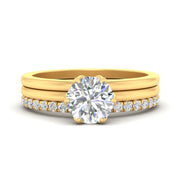


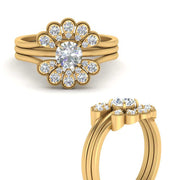


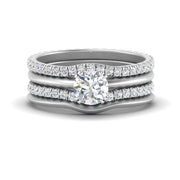

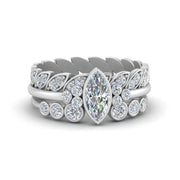






Real Customer Reviews
What Are Stacked Engagement Rings?
Stacked engagement rings are two or more rings worn together on the same finger — typically a center stone engagement ring paired with one or more diamond bands, wedding bands, or accent rings. The stack is built around the engagement ring as the anchor piece, with flanking bands chosen to complement rather than compete with the center stone.
The appeal of the stacked ring look comes from its layered visual depth. Where a single solitaire presents one clean line of metal and stone, a stack creates dimension, texture, and movement across the finger. It's a format that grows over time — a wedding band added at marriage, an eternity band at a milestone anniversary, a slim accent band as a personal gift — each ring adding a layer of meaning to the overall piece.
Stacked engagement rings are also one of the most versatile bridal jewelry formats. The same engagement ring can anchor a minimal two-piece stack for daily wear and a fuller three or four-piece stack for special occasions, simply by adding or removing flanking bands.
How to Build a Stacked Engagement Ring Set
Start with the anchor ring. The engagement ring is the foundation of every stack. Its setting style, band width, and profile determine which bands will sit flush alongside it and which will create gaps or alignment issues. Before selecting stacking bands, identify your engagement ring's specifications: band width, setting height, and whether the base of the setting is flat or curved.
Choose bands that sit flush. The most common stacking problem is a gap between the engagement ring and the flanking band — caused by a high-profile setting or a curved ring base that prevents a straight band from sitting flush. For engagement rings with elevated settings (halo, cathedral, or tall prong solitaires), a contoured or curved wedding band is essential. For lower-profile settings (bezel, low prong solitaire, east-west), a straight band typically sits flush without a gap.
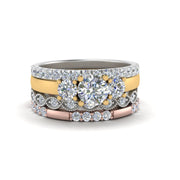
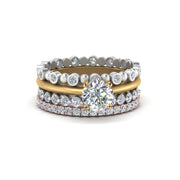
Match or intentionally mix metals. The most cohesive stacks match metal tone across all rings — all white gold, all yellow gold, or all rose gold. Mixed-metal stacks are equally valid as a deliberate aesthetic choice: a yellow gold engagement ring flanked by a white gold pavé band and a rose gold plain band creates a warm, layered combination. The key is intentionality — a consistent two or three-metal palette rather than random variation.
Balance diamond weight across the stack. A heavily diamond-set engagement ring — a large halo or full pavé band — pairs best with slimmer, more restrained flanking bands. A simple solitaire can support more elaborate flanking bands without the stack feeling top-heavy. The goal is for the engagement ring to remain the visual focal point regardless of how many bands flank it.
Consider band width proportions. Place the widest ring at the bottom of the stack and work narrower toward the top. This creates visual stability — a stack that appears grounded rather than precarious. Mixing band widths (a 2mm pavé band, a 1.5mm plain band, a 2.5mm eternity band) creates more visual interest than three identical-width bands.
Stacked Ring Styles at Fascinating Diamonds
Solitaire + Wedding Band: The classic two-piece stack. A center stone ring paired with a single diamond or plain metal band. The most understated configuration and the most practical for daily wear — the engagement ring reads clearly as the anchor, and the wedding band adds a second line of metal and diamond alongside it.
Solitaire + Pavé Band + Accent Band: A three-piece stack with graduated diamond density. The solitaire anchors the look, the pavé band adds a continuous line of brilliance on one side, and a slim plain or textured accent band on the other side frames the engagement ring symmetrically. This is the most popular three-piece stacking configuration.
Eternity Band Stack: One or two diamond eternity bands flanking a center stone ring. Eternity bands — with diamonds set around the full circumference — create the most continuous diamond presence across the stack. Full eternity bands cannot be resized, so accurate ring sizing before ordering is essential.
Mixed-Width Stack: Combining bands of different widths — a 3mm eternity band, a 1.5mm pavé band, and a 1mm plain band — creates a layered, textural look that reads as curated rather than uniform. Mixed-width stacks work best with a consistent metal tone across all rings.
Curved Band Stack: For engagement rings with elevated settings, a contoured or curved wedding band is designed with a slight arch that nestles against the setting's base, eliminating any gap between the rings. Curved bands create the most integrated, flush look for complex engagement ring settings.
East-West Stack: An east-west set center stone — horizontally oriented across the finger — creates a unique stacking geometry. Because the stone runs across the finger rather than projecting upward, slim bands sit naturally on either side without height conflict. East-west stacks suit minimalist, architectural aesthetics.
Diamond Shapes That Stack Best
Round Brilliant: The most universally stackable center stone. Its symmetrical, circular profile creates no directional preference for flanking bands — straight bands sit flush alongside it in any configuration.
Oval: The second most popular stacking center stone. The oval's elongated profile creates a natural horizontal visual line that slim flanking bands complement without interruption. Oval stacks in yellow gold with slim pavé bands are one of the most sought-after contemporary bridal configurations.
Cushion: Cushion cuts with their rounded corners pair naturally with both straight and curved bands. The softer geometry of the cushion creates a forgiving profile that works with most band styles.
Emerald Cut: The most architectural stacking center stone. An emerald cut's clean rectangular lines and flat table surface create a strong graphic anchor for a slim, restrained flanking band stack. Straight bands in matching metal are the most natural pairing.
Pear and Marquise: Elongated shapes with pointed ends require careful band selection — the point must clear the flanking band without rubbing. Low-profile prong or bezel settings with a V-prong protecting the tip allow straight bands to sit alongside without contact.
Metals for Stacked Engagement Ring Sets
White Gold: The most popular metal for stacked bridal sets. Its neutral tone creates maximum diamond visibility across all rings in the stack and coordinates naturally with platinum.
Yellow Gold: The dominant contemporary choice. Yellow gold stacks — particularly solitaire in yellow gold with slim pavé flanking bands — are the most widely photographed and purchased bridal configuration in current fine jewelry. 14k yellow gold offers strong durability for daily-wear stacks with multiple rings creating friction between surfaces.
Rose Gold: The most romantic stacking metal. Rose gold's warm pink tone creates a distinctive look, particularly effective in three-ring stacks where all three rings share the rose gold tone.
Platinum: The most durable option for high-value stacked sets. Platinum's density makes it the most scratch-resistant metal for rings worn in constant contact with each other, which is particularly important in a stack where multiple rings create friction between surfaces daily.
Mixed Metals: Two or three metal tones combined across the stack. Most effective when the combination is intentional and consistent — yellow gold anchor ring with white gold flanking bands is the most common mixed-metal stack configuration.
Natural vs Lab-Grown Diamonds in Stacked Ring Sets
Stacked ring sets contain more total diamond weight than single-stone rings — a three-piece stack with a 1-carat center stone and two pavé flanking bands may contain 1.5 to 2 total carats across the set. This makes the natural vs lab-grown decision particularly consequential for budget allocation.
Lab-grown diamonds are chemically and optically identical to natural diamonds — the same brilliance, hardness, and GIA or IGI grading standards. They cost 50–70% less per carat than natural diamonds of equivalent quality. For stacking bands specifically — where the diamonds are smaller and set across a wider area — lab-grown diamonds deliver the same visual result at a fraction of the natural diamond cost, freeing budget for the center stone or a higher-quality metal.
At Fascinating Diamonds, both natural and lab-grown options are available across all stacked ring configurations, with full GIA or IGI certification details on every product page.
Caring for a Stacked Ring Set
Multiple rings worn together require more maintenance attention than a single ring:
- Clean the full stack together every two to four weeks — dirt and oil accumulate in the gaps between rings where they contact each other
- Separate the rings for cleaning — remove each ring individually, clean with warm water and mild dish soap using a soft brush, and allow each piece to dry fully before reassembling the stack
- Check for ring-on-ring wear at annual professional inspections — rings in constant contact gradually wear each other's metal surfaces; a jeweler can identify and address wear points before they become structural issues
- Store stacked rings separately — storing multiple rings together in a pouch or box creates scratching between metal surfaces; individual fabric pouches or a divided jewelry box is best practice
FAQs For Stacked Engagement Rings for Women
1. What are stacked engagement rings?
Stacked engagement rings are two or more rings worn together on the same finger — typically a center stone engagement ring paired with one or more diamond bands or accent rings. The engagement ring serves as the anchor piece, with flanking bands chosen to complement and frame it. The stack can be built gradually over time, with each new ring marking a milestone.
2. How many rings should be in a stack?
Two to four rings is the most practical and visually balanced range. A two-ring stack — engagement ring and wedding band — is the most classic configuration. Three rings is the most popular for a curated bridal stack. Four rings creates a bolder, more fashion-forward look. Beyond four rings on a single finger, comfort and proportion typically become limiting factors.
3. What is the best wedding band to stack with an engagement ring?
The best stacking band depends on the engagement ring's setting profile. For low-profile settings (bezel, low solitaire), a straight pavé or plain metal band sits flush without a gap. For elevated settings (halo, cathedral, high prong), a contoured or curved band is essential to eliminate the gap between the rings. Always match or intentionally mix metal tones for a cohesive stack.
4. Can you stack rings with an east-west engagement ring?
Yes. East-west engagement rings — with the center stone oriented horizontally across the finger — are naturally suited to stacking because the stone sits low and creates no height conflict with flanking bands. Slim straight bands on either side of an east-west ring are the most effective configuration.
5. Do stacked rings scratch each other?
Rings of the same metal type worn in constant contact will develop minor surface wear over time. This is most visible on high-polish finishes and less apparent on pavé or textured surfaces. Platinum is the most scratch-resistant metal for stacked sets. Annual professional inspection identifies and addresses wear points before they become structural issues.
6. Should stacked rings match in metal?
Matching metals creates the most cohesive, unified look. Mixed metals are equally valid as a deliberate aesthetic choice — yellow gold with white gold is the most popular mixed-metal combination in stacked bridal sets. The key is intentionality: a consistent two or three-metal palette rather than mismatched pieces worn together by default.
7. Are lab-grown diamonds good for stacking bands?
Yes. Lab-grown diamonds are identical to natural diamonds in every measurable way and cost 50–70% less per carat. For flanking bands in a stacked set — where smaller diamonds are distributed across the band — lab-grown stones deliver the same visual result at significantly lower cost, allowing more budget to be directed toward the center stone or metal quality.
8. Can eternity bands be resized for a stacked set?
Full eternity bands — with diamonds set around the complete circumference — cannot be resized. Half eternity bands, with diamonds across the top half and plain metal underneath, can be resized by one size in either direction. If ring size accuracy is uncertain, a half eternity band is the more practical choice for a stacked set.