

Black Diamond Bracelets for Women
Black diamonds are genuine diamonds, rated 10 on the Mohs hardness scale and identical in hardness and durability to colorless diamonds. Their opaque, deep black color and polished surface luster create a visual character that no other gemstone replicates on the wrist. Every bracelet in this collection features certified lab-grown black diamonds set in 14K or 18K white gold, yellow gold, rose gold, black gold, or platinum with your choice of natural or lab-grown white diamond accents. Styles include tennis bracelets, chain bracelets, and bangle bracelets across 20 designs. Prices start at $604. All pieces are made in the USA with free shipping and easy financing.
Explore Our Black Diamond Bracelets Collection










Real Customer Reviews
What Black Diamond Bracelets Offer That No Other Bracelet Does
Black diamond bracelets do not look like any other fine jewelry bracelet available. That distinction is precise and optical, not promotional. Colorless diamond bracelets derive their visual quality from internal brilliance, the way light enters the stone, refracts through the crystal structure, and exits as white and spectral flashes. Black diamond bracelets work entirely differently. Black diamonds absorb light rather than transmitting it. Their visual quality comes from surface luster, a polished, mirror-like reflection from their facets that creates a deep, graphic presence along the wrist.
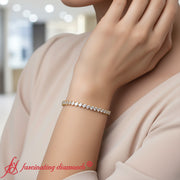
On the wrist, this means a black diamond tennis bracelet or chain bracelet reads through contrast rather than brightness. The dark stones against metal, against skin, and against clothing create an immediate, graphic visual that colorless diamond jewelry does not produce. At a distance, a black diamond bracelet reads as a bold wrist statement. Up close, the polished surface of each stone reflects the environment around it in a low, deep way that is more architectural than luminous.
This quality also makes black diamond bracelets exceptionally versatile. Because black is inherently neutral, black diamond pieces coordinate with every outfit color and every metal tone without creating the color-matching considerations that blue sapphire, ruby, or emerald bracelets introduce. They suit formal occasions and everyday wear without modification.
Lab-Grown Black Diamonds: What This Collection Offers
Every black diamond in this collection is lab-grown. Lab-grown black diamonds are genuine diamonds, sharing the same chemical composition (carbon in cubic crystal structure) and the same Mohs 10 hardness as natural black diamonds. The only difference is origin.
Black diamonds, both natural and lab-grown, get their color from a dense concentration of graphite inclusions distributed throughout the crystal structure. These inclusions absorb rather than reflect light, producing the opaque black appearance. Lab-grown black diamonds are produced using high-pressure, high-temperature (HPHT) or chemical vapor deposition (CVD) processes, with conditions calibrated to generate this graphite inclusion density within the diamond crystal. The result is a stone chemically and physically identical to a natural black diamond.
Lab-grown black diamonds achieve more consistent, uniform color distribution than natural black diamonds in the same price range. For a bracelet where multiple black diamonds appear side by side in a tennis line or at intervals along a chain, this uniformity means every stone reads the same deep black, creating visual consistency across the full length of the piece. Lab-grown black diamonds also cost less per stone than natural equivalents, making larger stone configurations and more elaborate designs accessible at lower price points.
Black Gold: What It Is and Why It Matters for Black Diamond Bracelets
This collection includes black gold as a metal option alongside white gold, yellow gold, rose gold, and platinum. Black gold is worth understanding before selecting it as a setting metal.
Black gold is standard gold at standard karat purity (14K or 18K) with a surface treatment applied to create a near-black color. The most common methods are rhodium plating to a near-black shade, chemical vapor deposition (CVD) coating, or laser oxidation treatments that darken the surface. The base metal retains its standard gold properties. The black finish is a surface layer.
In a black diamond bracelet, black gold creates a fully tonal, monochrome composition. Stone and metal are both deep black. There is no contrast between setting and stone — instead, the bracelet reads as a single unified surface of deep, matte-reflective black with dimensional variation between the faceted stone faces and the smooth metal. This is the most visually bold option and suits buyers who want a fully non-traditional bracelet with no color contrast element.
Black gold requires more maintenance than standard metal finishes over time. The surface treatment can be worn at contact points, particularly on a bracelet that experiences consistent wrist contact. Buyers who choose black gold should factor in periodic refinishing as part of their long-term care expectation.
Black Diamond Bracelet Styles and Prices
This collection spans three bracelet formats across 20 designs. Prices are in black diamond configuration across all metal options.
Tennis bracelets set black diamonds in a flexible continuous line around the full wrist. Six designs cover the primary tennis formats.
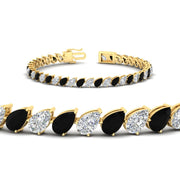
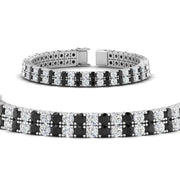
The 2-carat diamond tennis bracelet is the collection's entry tennis design, with round black diamonds in prong settings on a flexible gold or platinum band. The 2.70 ct bezel-set tennis bracelet encloses each black diamond in a continuous metal rim, the most protective setting format and the one that creates the cleanest graphic outline for the stone's opaque surface. The stunning two-row tennis bracelet and the 2-row round tennis bracelet both double the black diamond coverage with parallel stone lines, creating substantially more visual presence and wrist coverage than single-row designs. The leaning pear cut tennis bracelet uses pear-shaped black diamonds oriented at a lean, creating directional geometric rhythm along the band. The zig-zag tennis bracelet sets black diamonds in an alternating high-low pattern for three-dimensional visual movement.
Chain bracelets suspend black diamonds from a delicate gold or platinum chain. These are the most layerable and everyday-versatile designs in the collection.
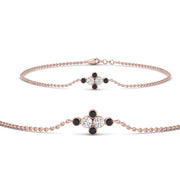
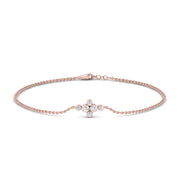
The bezel-set single chain bracelet is the collection's most minimalist design, suspending a single bezel-set black diamond from a delicate chain. The 0.25 ct bezel-set emerald cut chain bracelet places a rectangular emerald-cut black diamond in a clean bezel setting, with the step-cut's flat table emphasizing the stone's surface luster particularly effectively. The cute disc chain bracelet features circular disc-shaped black diamond elements along the chain. The cute lotus chain bracelet centers a lotus flower motif in black diamond and white diamond accents on a fine chain. The butterfly cute chain bracelet uses a black diamond and white diamond butterfly as the chain centerpiece. The four-stone chain bracelet spaces four round black diamonds evenly along the chain. The 3-stone chain bracelet places three black diamonds at the center. The round halo chain diamond bracelet places a black diamond center in a full white diamond halo suspended from a diamond-accented chain, which produces one of the strongest black-and-white contrasts in the chain bracelet category. The bezel-set chain bracelet sequences multiple bezel-set round black diamonds along the band. The heart interlocked chain bracelet uses interlocking heart forms set with black diamonds and white diamond accents. The pave infinity chain bracelet features a pave-set infinity symbol in black diamonds and white diamonds. The round gold chain bar bracelet places a horizontal bar-set black diamond as the chain's central element.
Bangle bracelets are rigid circular forms. The 3-stone bracelet bangle places three black diamonds in a prong setting on the bangle face. The minimalist solitaire bangle bracelet places a single black diamond at the top of a clean, unadorned bangle, making the stone the sole visual element of the design and the most refined piece in the collection.
How Black Diamonds Differ Optically From Colorless Diamonds
Understanding this distinction matters for selecting settings and for styling the bracelet effectively.
Colorless diamonds are cut to maximize light return through the crown facets. Prong settings that minimize metal coverage are preferred because they allow maximum light entry from below. The stone's visual quality comes from what happens inside it.
Black diamonds are cut for surface precision and outline rather than light performance. The stone's visual quality comes from its face, not from internal refraction. Cut shapes that emphasize flat surface area perform particularly well for black diamonds. The emerald cut, asscher cut, and cushion cut all create broader, flatter faces than round cuts and maximize the mirror-like surface that defines the stone's character.
In bracelet settings, this means bezel designs that frame the stone's face with a clean metal outline often present black diamonds more effectively than prong settings that expose the girdle. The round halo chain bracelet, where a ring of white diamond brilliance surrounds the black center, uses contrast to create the brightness that the black diamond itself cannot produce. This combination delivers both depth and brightness in a single piece.
Metal Pairings for Black Diamond Bracelets
Black gold creates a fully monochrome tonal pairing unique to black diamond jewelry. Stone and metal are both deep black. This is the most visually bold option, suited to buyers who want the bracelet to read as a single graphic statement with no color contrast between stone and setting.
Rose gold is the most popular current metal pairing for black diamonds. The warm pinkish-rose tone against deep opaque black creates an editorial, high-contrast combination that reads as contemporary and fashion-forward. Rose gold black diamond bracelets, particularly chain and halo chain designs, are among the strongest-performing designs for buyers in the current market.
White gold and platinum create the maximum graphic contrast with black diamonds. The cool bright metal against the dark stone is sharp and immediate, giving black diamond bracelets in white metal a clean, architectural character. This pairing suits buyers who want the bracelet to read as a strong black-and-white statement. Platinum is more durable long-term, hypoallergenic, and requires no rhodium plating. White gold costs less at purchase but needs periodic replating.
Yellow gold creates the highest warmth contrast against black diamonds and carries art deco precedent. Black and gold is one of the most enduring two-tone combinations in design history. Yellow gold black diamond bracelets have a bold, graphic quality that suits buyers drawn to historically-informed aesthetics.
All bracelets are available in 14K and 18K versions of each metal plus black gold in both karat weights. 14K gold is harder and more scratch-resistant, which matters for bracelets subject to consistent wrist contact. 18K gold carries higher pure gold content and richer color tone.
Stacking Black Diamond Bracelets
Black diamond bracelets are the most effective anchor stones for wrist stacks in the entire gemstone bracelet range, for one precise reason: black is inherently neutral. Where blue sapphire, ruby, and emerald bracelets create specific color relationships with adjacent pieces and with clothing, black diamond bracelets stack with everything without adjustment.
The most effective stacking principle for black diamond bracelets: use the dark stone as the visual anchor and layer lighter pieces around it. A black diamond tennis bracelet as the foundational piece, with a thin white diamond chain bracelet above it and a plain gold chain as the outermost element, creates a three-tier gradient from dark to light that reads as composed and intentional.
Black diamond chain bracelets are specifically proportioned for layering. The single-stone, three-stone, and four-stone chain designs sit cleanly alongside tennis bracelets, bangles, and plain chains without visual conflict. Their delicate scale means they add black diamond color to a stack without adding visual weight.
For a fully monochromatic black and gold stack, layer a black gold black diamond tennis bracelet with a black gold chain bracelet and a plain black gold chain. The fully black arrangement creates maximum dramatic effect for buyers who want no metal color contrast anywhere in the stack.
For a black-and-white stack, mix black diamond and colorless diamond pieces at different scales. The tonal contrast reads across the full wrist arrangement in the same way it reads within a single halo pendant design.
Bracelet Sizing
Tennis bracelets, chain bracelets, and bangles each require different sizing approaches.
For tennis bracelets, the standard women's length is 7 inches, suiting most wrists between 6 and 7 inches. Measure the wrist at its widest point below the wrist bone and add 0.5 to 0.75 inches. A correctly fitted tennis bracelet slides over the hand when flat but does not rotate freely on the wrist. Custom lengths are available from Fascinating Diamonds.
For chain bracelets, most designs include an adjustable extender of 0.5 to 1 inch at the clasp. Measure the wrist and select the chain length that sits comfortably without sliding toward the back of the hand.
For bangle bracelets, measure across the widest point of the hand when the thumb and pinkie are pressed together, the position required to slip the bangle on. A correctly fitting bangle slips over the hand with slight resistance and sits at the wrist without falling toward the knuckles.
Black Diamond Bracelet Care
Black diamonds require specific care considerations distinct from colorless diamonds, due to their graphite inclusion structure.
Clean black diamond bracelets with warm water, mild dish soap, and a soft-bristle brush only. Work gently along the full length of the bracelet, paying attention to the underside of settings where skin oils accumulate. Rinse thoroughly and dry with a lint-free cloth. Manual cleaning is both safe and sufficient for black diamonds.
Do not use ultrasonic cleaners on black diamond bracelets. The graphite inclusions that give black diamonds their color make the stone more susceptible to internal fracturing under vibration than clean colorless diamonds. This applies to lab-grown black diamonds as well as natural ones, because the graphite inclusion structure is present in both and is the source of the color, not a post-growth treatment.
Do not use steam cleaners. Sudden thermal shock from steam can stress the stone along fracture planes.
For black gold bracelets specifically, avoid abrasive cleaning materials and harsh chemicals. The black surface treatment is a coating rather than a solid metal property. Abrasive contact and strong chemicals can wear the black finish at contact points over time. This means black gold bracelets require more attentive care than standard metal versions of the same designs.
Remove the bracelet before activities involving direct impact, heavy manual work, or chemical exposure, including swimming in chlorinated water.
Store black diamond bracelets separately from other jewelry to prevent tangling and to avoid the diamond's hardness (Mohs 10) abrading softer metal surfaces in storage.
Annual professional inspection is recommended for tennis bracelet settings and clasps.
FAQs For Black Diamond Bracelets for Women
1. Are black diamonds real diamonds?
Yes. Black diamonds are genuine diamonds composed of carbon in the same cubic crystal structure as colorless diamonds. They share Mohs 10 hardness and are distinguished from colorless diamonds only by their graphite inclusion content, which produces the opaque black color.
2. Are lab-grown black diamonds treated to achieve their color?
No. Lab-grown black diamonds at Fascinating Diamonds achieve their black color through the same graphite inclusion structure that occurs in natural black diamonds, produced during the HPHT or CVD growth process. They are not post-growth irradiated or chemically treated to create the color.
3. Do black diamond bracelets sparkle?
Black diamonds do not produce the internal brilliance and fire of colorless diamonds. They produce surface luster, a deep, polished, mirror-like reflection from their facets. The visual effect is graphic and bold rather than bright. Designs that pair black diamonds with white diamond accents, such as the round halo chain bracelet, add white diamond brilliance alongside the black stone's depth.
4. Are black diamond bracelets durable enough for everyday wear?
Yes. Black diamonds rate Mohs 10 and resist scratching from all everyday contact. The graphite inclusions make them somewhat more brittle than clean colorless diamonds under sharp blunt impact, but for a bracelet worn with reasonable care, they are fully suitable for daily wear.
5. Can I clean a black diamond bracelet with an ultrasonic cleaner?
No. Ultrasonic cleaning is not recommended for black diamonds. The graphite inclusion density makes the stone susceptible to fracturing under vibration. Clean only with warm water, mild soap, and a soft brush.
6. What is black gold and how does it wear over time?
Black gold is standard gold at 14K or 18K purity with a surface treatment applied to create a near-black color. The black finish can wear at contact points over time and may require periodic refinishing. It is the most visually bold metal option for black diamond jewelry but requires more maintenance than standard metal finishes.
7. What metal looks best with a black diamond bracelet?
Rose gold is the most popular current choice for its warm editorial contrast. White gold and platinum provide maximum graphic contrast. Yellow gold creates a bold art deco-adjacent combination. Black gold creates a fully monochrome tonal pairing unique to black diamond jewelry. All are available in this collection.
8. How do black diamond bracelets stack with other jewelry?
Black diamond bracelets are the most versatile anchor piece for wrist stacks because black is neutral and coordinates with every metal tone and outfit color without adjustment. Layer with white diamond tennis bracelets and plain metal chains for a graduated tonal stack. Mix black gold and standard gold pieces for a fully monochromatic arrangement.
9. Are the black diamonds in this collection natural or lab-grown?
All black diamonds in this collection are lab-grown. They are genuine diamonds with the same hardness and visual character as natural black diamonds, with more consistent color distribution and at lower price points than comparable natural stones.
10. What is the price range for black diamond bracelets at Fascinating Diamonds?
Prices start at $604 for chain bracelet designs and reach $10,646 for the two-row tennis bracelet, across 20 designs in tennis, chain, and bangle formats in all metal options including black gold.