

Ruby Wedding Bands and Wedding Rings for Women
Ruby is one of the most symbolically powerful gemstones in the history of fine jewelry, associated with love, passion, and lifelong devotion across cultures for centuries. Every band in this collection features certified lab-grown rubies rated 9 on the Mohs hardness scale, set in 14K or 18K white gold, yellow gold, rose gold, or platinum with your choice of natural or lab-grown diamond accents. Styles include eternity, half-eternity, 5-stone, 7-stone, crisscross weave, nature-inspired, vintage, contour, and matching set designs. All bands are made in the USA with free shipping and easy financing.
Explore Our Ruby Wedding Rings and Wedding Bands Collections







Real Customer Reviews
Why Ruby Wedding Bands Carry Lasting Meaning
Ruby has been associated with the heart, with love, and with enduring commitment longer than almost any other gemstone. In Sanskrit, ruby was "ratnaraj," the king of gemstones. Ancient Burmese warriors embedded rubies in their skin believing the stones conferred invincibility in battle. Medieval European nobility wore rubies at weddings as symbols of protection and passion. The Mughal emperors inscribed their finest rubies with verses and presented them as tokens of royal devotion.
That history translates directly into what a ruby wedding band communicates today. It is a choice that draws on one of the deepest and most consistent symbolic traditions in jewelry, a stone that has meant love, fire, and commitment across every culture that has encountered it. A ruby wedding band worn daily is both a practical object and a statement that carries genuine cultural weight.
Ruby also earns its place on practical grounds. At 9 on the Mohs hardness scale, it matches sapphire as the second hardest gemstone after diamond. It resists scratching from everyday contact and holds its color and surface quality over decades of continuous wear without degradation.
Lab-Grown Ruby Wedding Bands
Every ruby in this collection is lab-grown. Lab-grown rubies are genuine rubies, sharing the same chemical composition as mined stones (aluminum oxide, Al₂O₃, with chromium as the coloring agent), the same corundum crystal structure, and the same 9 Mohs hardness. The only difference is origin.
For a wedding band where multiple rubies are set side by side across a continuous band, lab-grown rubies offer a consistent advantage in color uniformity. Natural rubies are subject to color zoning, subtle variations in saturation and tone caused by uneven chromium distribution during crystal growth. In a ring where several small rubies appear adjacent, this variation is visible. Lab-grown rubies are produced under controlled conditions that deliver consistent, vivid red color across every stone in the band.
Lab-grown rubies also achieve higher eye clarity than most commercially available natural rubies in the same price range. Natural rubies almost always contain inclusions. Lab-grown stones are typically eye-clean, which means the ruby's red color reads without visual interruption across the band's surface. For a wedding band worn and observed daily over a lifetime, these qualities matter.
Ruby Wedding Band Styles
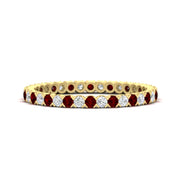
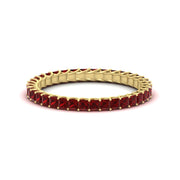
Eternity bands set rubies continuously around the full circumference of the band, creating uninterrupted color from every angle. Full ruby eternity bands are the most formal and visually complete style, suited to buyers who want maximum color presence or who are wearing the band as a standalone piece rather than paired with an engagement ring. Ruby and diamond alternating eternity bands, with rubies and diamonds set in sequence, create a more dynamic visual rhythm.
Half-eternity bands set rubies across the top portion of the band only. This style is more practical for daily wear because the band can be resized without disturbing the stones, which is not possible with full eternity bands. Half-eternity designs also allow pairing with a wider range of engagement ring styles because the bottom of the band is plain metal, sitting flush against adjacent rings.
5-stone and 7-stone bands place a specific number of rubies across the center of the band, typically flanked by diamond accents. These designs have a more measured, composed quality than full eternity bands and pair easily with solitaire or simple engagement rings. The graduated sizing of stones in some 5-stone designs creates a subtle taper that flatters the finger.
Crisscross weave bands interlock metal elements in a woven or crossover pattern, with rubies set at the intersections or along the weave. These designs have a distinctive architectural quality and read as more fashion-forward than traditional band formats. They work well as standalone anniversary bands or as statement pieces in a ring stack.
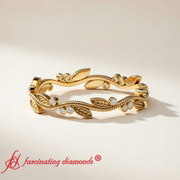
Nature-inspired bands incorporate leaf, vine, floral, and organic motifs alongside rubies. These designs reference the natural world in their metalwork and pair ruby's vivid red with the visual vocabulary of botanical jewelry. They suit buyers drawn to organic aesthetics and pair naturally with vintage or nature-inspired engagement rings.
Vintage and antique-inspired bands feature milgrain edging, filigree patterns, scroll work, and art deco geometry alongside rubies. Given ruby's centuries-long history in fine jewelry, vintage-style metalwork feels historically coherent with the stone. Leaf pattern, filigree, and milgrain designs from this collection are among the most consistently requested ruby band styles.
Contour bands are shaped to fit flush against a specific engagement ring profile, typically following the curve of a halo or curved solitaire setting. These are designed to be worn as a matched set with a specific engagement ring rather than as standalone pieces.
His-and-hers matching sets pair coordinated ruby bands for two wearers, typically featuring a wider men's band and a narrower women's band in complementary designs. The unified love band design in this collection uses a split-heart motif that completes across both rings when worn together.
Best Settings for Ruby Wedding Bands
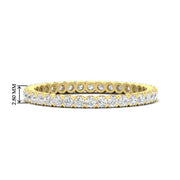
Pave settings cluster small rubies close together with minimal metal visible between them, creating a surface of dense, continuous color. Pave ruby bands have maximum visual intensity and work well both as standalone pieces and as accent bands in a stack. Pave settings require the most precise craftsmanship to execute well, as each stone must be set individually with consistency across the full band.
Channel settings run rubies in a continuous row within a groove between two raised metal walls. The stones sit flush with or slightly below the surface, fully protected on all sides. Channel-set ruby bands are the most practical choice for active wearers. The clean, streamlined profile suits contemporary and minimalist aesthetics.
Prong settings hold each ruby with individual metal claws, maximizing light exposure around the stone and allowing the ruby's color to read from multiple angles. Prong-set ruby bands have a more traditional, delicate appearance and show more of each stone's face. They require periodic inspection to ensure prongs remain tight and secure.
Bezel settings enclose each ruby in a continuous metal rim, offering maximum protection and a clean modern outline. Bezel-set ruby bands are the most protective individual-stone format and give the band a bold, graphic quality. The metal border emphasizes each stone's shape and contributes to the ring's overall structure.
Metal Pairings for Ruby Wedding Bands
Yellow gold is ruby's most historically established pairing and the one with the deepest precedent across every major jewelry tradition. Red and gold appear together in Roman, Byzantine, Mughal, and Victorian jewelry. The warm metal amplifies ruby's red and creates a rich, formal combination that reads as both traditional and opulent. Several designs in this collection, particularly the vintage and nature-inspired styles, were built with yellow gold as the primary metal.
Rose gold creates tonal harmony with ruby. The warm pinkish-rose metal echoes the warmth of the stone's red without competing with it. This pairing has a romantic, contemporary character and is among the most popular current choices for ruby bands. Crisscross, weave, and nature-inspired designs translate particularly well in rose gold with ruby.
White gold and platinum provide cool, high-contrast framing for ruby's red. The opposition between bright neutral metal and vivid red is sharp and graphic. White metal ruby bands suit buyers who want the stone's color to carry maximum visual intensity without any warmth interaction from the metal. Platinum is more durable long-term, fully hypoallergenic, and does not require rhodium plating. White gold costs less at purchase but requires periodic replating to maintain its appearance.
All bands are available in 14K and 18K versions of each metal. 14K gold is harder and more scratch-resistant. 18K gold carries a higher pure gold content and richer color tone.
Pairing a Ruby Wedding Band with an Engagement Ring
Ruby wedding bands pair most naturally with ruby engagement rings, where the color relationship between band and ring creates visual continuity across the set. A channel or pave ruby band alongside a ruby halo engagement ring extends the color of the center stone into the band, creating a fully unified bridal set.
Ruby bands also pair effectively with colorless diamond engagement rings as a color accent. A thin pave ruby band alongside a diamond solitaire introduces warmth and color to a ring stack without competing with the center stone. The contrast between the diamond's brilliance and the ruby's vivid red creates a dynamic rather than a uniform stack.
For buyers who want to balance color and tradition, alternating ruby and diamond eternity bands offer a middle path. The ruby stones appear at intervals against diamond accents, providing color without full ruby saturation across the band.
Contour bands from this collection are designed to fit specific engagement ring profiles. These are best selected alongside the engagement ring to ensure the curvature matches and the two rings sit flush together without gaps.
Ruby Wedding Band Care
Lab-grown rubies require minimal maintenance. Clean with warm water, mild dish soap, and a soft-bristle brush. Scrub gently around each stone and setting, rinse thoroughly, and dry with a lint-free cloth. This removes the oils, lotions, and product buildup that accumulate with daily wear and progressively dull the stone's surface.
Ultrasonic and steam cleaning are both safe for lab-grown rubies. These methods are particularly useful for reaching between tightly set pave or channel stones where a brush cannot access fully.
Remove ruby bands before activities involving direct impact, heavy manual work, or strong chemical exposure. Household bleach, chlorine, and acetone can damage metal settings over time. Remove the band before swimming in chlorinated pools.
For pave and channel settings with multiple small stones, professional inspection once a year is recommended. Small stones in close-set configurations are more prone to loosening over time than larger individually set stones.
FAQs For Ruby Wedding Bands and Wedding Rings for Women
1. Are ruby wedding bands durable enough for daily wear?
Yes. Ruby rates 9 on the Mohs hardness scale, second only to diamond. It resists scratching from virtually all everyday contact and maintains its color and surface quality over decades of continuous wear.
2. What does a ruby wedding band symbolize?
Ruby has symbolized love, passion, protection, and enduring commitment across cultures for centuries. It is one of the most historically consistent symbols of romantic devotion in fine jewelry and is considered among the most meaningful gemstones for marriage.
3. Are the rubies in these bands natural or lab-grown?
All rubies in this collection are lab-grown. Lab-grown rubies are genuine rubies, chemically and physically identical to mined stones, offering superior color consistency and clarity for band applications where multiple stones appear side by side.
4. Can a ruby wedding band be resized?
Half-eternity, 5-stone, and 7-stone band styles can generally be resized by a skilled jeweler. Full eternity bands cannot be resized without removing stones, as the stones run continuously around the full band. Accurate sizing at purchase is essential for full eternity styles.
5. What is the best setting for a ruby wedding band for active wear?
Channel and bezel settings are the most practical for active lifestyles. Channel settings enclose stones between two metal walls with no exposed prongs. Bezel settings surround each stone in a full metal rim. Both eliminate the prong-catching risk that prong-set designs carry.
6. What metal works best with a ruby wedding band?
Yellow gold is the most historically established pairing and amplifies ruby's warmth. Rose gold creates tonal harmony with the stone's red. White gold and platinum provide high-contrast framing that intensifies the ruby's color. All metals are available in this collection.
7. How do I pair a ruby wedding band with a diamond engagement ring?
A pave or channel ruby band pairs cleanly alongside most diamond engagement rings, adding color without competing with the center stone. Alternating ruby and diamond bands offer a more measured color introduction. For a fully coordinated set, pair a ruby band with a ruby engagement ring from the same collection.
8. What ruby band styles are available at Fascinating Diamonds?
This collection includes eternity, half-eternity, 5-stone, 7-stone, crisscross weave, nature-inspired, vintage, contour, and his-and-hers matching set designs in pave, channel, bezel, and prong settings across all metal options.