

Gay and Lesbian Engagement Rings & Wedding Rings
Love is the only requirement. Every ring in this collection is designed for couples who want a certified diamond engagement ring that reflects their relationship — not a set of conventions built for someone else's. GIA and IGI certified diamonds, solid gold and platinum settings, made in the USA. No rules. Every style. Your story, your ring.
Explore Our LGBTQ+ Engagement Rings Collection








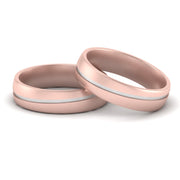

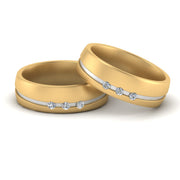

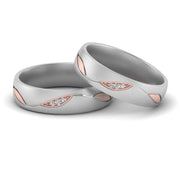

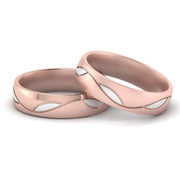




Real Customer Reviews
Engagement Rings for Same-Sex Couples
Gay and lesbian engagement rings are engagement rings chosen by same-sex couples to mark a proposal, commitment, or milestone in their relationship. They are, fundamentally, engagement rings — the same certified diamonds, the same metals, the same craftsmanship as any other fine jewelry engagement ring. What's different is the freedom that comes with choosing one.
Heterosexual engagement ring conventions — one partner proposes, one partner receives a ring, the ring sits alone until a wedding band joins it — don't apply by default to same-sex couples. LGBTQ+ couples approach engagement ring decisions with more flexibility and fewer inherited expectations: both partners may exchange rings, neither may, one may propose with a ring while the other chooses their own, or the couple may select rings together. The ring isn't shaped by convention. It's shaped by the relationship.
This guide covers everything relevant to choosing an engagement ring as a gay or lesbian couple — styles, settings, which finger to wear it on, matching vs individual rings, and everything in between.
Who Wears the Engagement Ring?
In a same-sex relationship, the question of who wears an engagement ring — and when — has no preset answer. There are several common approaches, all equally valid:
One partner proposes with a ring. The proposing partner presents a ring at the proposal moment. This follows the conventional engagement ring format — one ring, one moment — and suits couples where one partner takes the proposal lead.
Both partners exchange rings at the proposal. Both partners give and receive rings either at the same moment or in separate proposals. This is one of the most popular approaches for same-sex couples — two rings, two proposals, complete symmetry.
The couple selects rings together. Both partners choose their engagement rings together after the commitment is made verbally, without a surprise element. This approach prioritizes getting exactly the right ring over the element of surprise.
One or both partners wear no engagement ring. Some couples skip the engagement ring entirely and go straight to wedding bands. This is a valid choice and one that more same-sex couples make than heterosexual ones — the engagement ring convention simply doesn't hold the same weight in all LGBTQ+ relationships.
There is no correct answer. The approach that feels most authentic to the relationship is the right one.
Ring Styles for Gay & Lesbian Couples
Same-sex couples choose the same engagement ring styles as any other buyer — the difference is in how those styles are selected and combined. The most popular styles in this collection:
Toi et Moi (Two Stone Ring) Two stones side by side, each representing one person in the relationship. The toi et moi is one of the most symbolically specific ring styles for same-sex couples — the equal-partner symbolism of two stones with no hierarchy maps naturally onto a relationship without prescribed gender roles. Mixed diamond shapes (oval and pear, round and emerald cut) or diamond and colored gemstone combinations create a ring that feels personal and distinctive rather than conventional.
Solitaire Engagement Ring A single center diamond in a minimal prong or bezel setting. The solitaire is the most classic and timeless engagement ring format — its simplicity lets the diamond's quality speak for itself. For same-sex couples who want a ring that looks unmistakably like an engagement ring without any ambiguity, the solitaire is the clearest choice. Available in round brilliant, oval, emerald cut, cushion, pear, and marquise center stones.
Halo Engagement Ring A center diamond surrounded by a border of smaller diamonds. The halo amplifies the visual size of the center stone and adds peripheral brilliance that makes the ring immediately striking. Halo rings are particularly popular for oval and cushion center stones — the halo follows the stone's silhouette and creates a statement piece that photographs exceptionally well.
Diamond Eternity Band A full or half eternity band — diamonds set continuously around the full or top half of the band — worn as an engagement ring or exchanged as a commitment band. Eternity bands suit couples who want a ring that can be worn in any context without the visual declaration of a traditional engagement ring setting. They also stack naturally as part of a future bridal set.
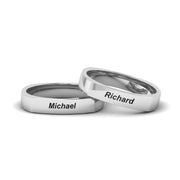
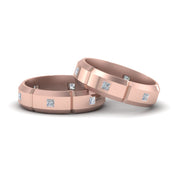
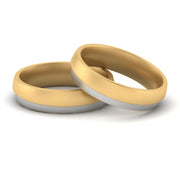
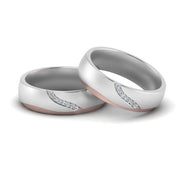
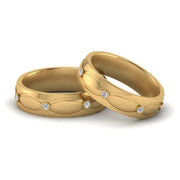
Matching Ring Sets Two rings designed to coordinate — either identical in every detail or complementary in design while sharing metal, stone shape, or setting style. Matching or complementary sets are popular among same-sex couples who want their rings to visually reference each other without being identical. A shared metal tone (both yellow gold) with different stone shapes (one oval, one pear) creates a cohesive set that honors both individuality and partnership.
Custom and Personalized Rings Engagement rings customized with personal details — an engraved date, initials, a birthstone incorporated alongside the center diamond, or a custom design that references something specific to the relationship. Custom rings are particularly meaningful for LGBTQ+ couples who want a ring that couldn't belong to anyone else.
Which Finger Does an Engagement Ring Go On?
The conventional placement for an engagement ring in the US is the fourth finger of the left hand — the ring finger — based on the ancient belief in the vena amoris, the vein running from that finger to the heart.
Many same-sex couples follow this convention without modification. Others make intentional choices about placement:
Right hand: Some LGBTQ+ individuals wear engagement and wedding rings on the right hand as a deliberate personal or cultural choice, or to distinguish their jewelry convention from the heterosexual norm. In several European countries, right-hand ring placement is the standard regardless of sexual orientation.
Left ring finger (conventional): The most widely recognized placement globally. Wearing the ring here communicates its significance immediately to anyone familiar with the convention.
Different fingers for different partners: Some same-sex couples wear their rings on different fingers intentionally — one on the left ring finger, one on the right — as a visual statement of individuality within the shared commitment.
There is no rule. The placement should feel meaningful to the wearer and comfortable for daily wear.
Matching vs Individual Rings
The question of matching rings is one of the most discussed among same-sex couples buying engagement jewelry. Both approaches are equally valid — the right choice depends on what the couple wants their rings to express.
Matching rings share the same metal, stone, setting, and design. The visual symmetry reinforces the equality of the relationship — both partners wearing identical rings as a deliberate symbol of shared commitment. Matching rings also have a practical advantage: they were designed together, so they're guaranteed to coordinate visually.
Complementary rings share key design elements — the same metal tone, similar band width, or related stone shapes — while differing in specific details. This approach honors both the partnership (shared visual language) and the individuality of each partner (different specific designs). A yellow gold oval solitaire and a yellow gold pear halo are complementary — clearly related, clearly distinct.
Individual rings are chosen entirely independently, with no design coordination required. The rings may look completely different, in different metals with different stones. This approach prioritizes each partner's individual style above visual coordination. For couples where personal expression is the primary value, individual rings make the most honest statement.
Diamond Quality for Same-Sex Engagement Rings
The 4Cs apply equally regardless of who is buying or wearing the ring. For gay and lesbian engagement rings specifically, a few quality considerations are worth highlighting:
Cut first, always. A well-cut diamond delivers superior brilliance regardless of its color or clarity grade. For any engagement ring — solitaire, halo, toi et moi — Excellent or Ideal cut is the most important quality decision.
For matching sets: Both stones should be closely matched in color and clarity so the rings read as visually consistent when worn side by side or photographed together. Aim for the same color grade (G-H minimum) and similar clarity (VS2-SI1) across both rings.
For mixed-shape toi et moi rings: Different shapes have different face-up sizes per carat. When pairing two stones, match by face-up appearance rather than carat weight to achieve visual balance between the stones.
GIA and IGI certification: Every diamond at Fascinating Diamonds is GIA or IGI certified, with full grading documentation on every product page. Certification protects you regardless of the ring style you choose.
Natural vs Lab-Grown Diamonds
Both natural and lab-grown diamonds are available across all styles in this collection. Lab-grown diamonds are chemically and optically identical to natural diamonds — same hardness, same brilliance, same GIA or IGI certification — at 50–70% less cost per carat.
For same-sex couples buying two rings — either a toi et moi with two center stones or a matching set for both partners — lab-grown diamonds offer meaningful budget advantages without any visual compromise. A matched pair of lab-grown oval diamonds in yellow gold solitaires delivers the same visual impact as natural diamonds of equivalent quality at a fraction of the natural diamond cost.
For couples who prioritize provenance — wanting the rarity and investment value of a naturally formed diamond — natural stones are available across the full collection with complete certification.
Metals for Same-Sex Engagement Rings
Yellow Gold (14k or 18k): The most popular contemporary choice. Warm, rich, and works naturally across all skin tones. Yellow gold toi et moi rings and matching yellow gold solitaire sets are the most widely purchased same-sex engagement ring configurations.
White Gold: Clean, neutral, and modern. Its cool tone maximizes diamond contrast and coordinates naturally with platinum and silver jewelry. White gold suits buyers whose existing jewelry vocabulary runs toward minimal and contemporary.
Rose Gold: The most romantic metal choice. Its warm pink tone creates a soft, feminine aesthetic that has made it consistently popular for lesbian engagement rings specifically. Rose gold matching sets are among the most requested same-sex ring configurations.
Platinum: The most durable and premium metal. Naturally white with no rhodium plating required, dense, and the most secure for stone settings. The right choice for high-value rings intended for decades of daily wear.
Mixed metals: Two partners choosing rings in different metals — one in yellow gold, one in white gold — is a valid and increasingly popular approach that honors individual aesthetic preferences within a shared commitment.
Pride-Inspired and Symbolic Details
Many LGBTQ+ couples choose to incorporate details that carry personal or community meaning into their engagement rings:
Rainbow gemstone accents: Small colored gemstones — sapphire, ruby, emerald, yellow sapphire, amethyst — incorporated as accent stones alongside or in place of diamonds, referencing the pride flag's spectrum of color.
Engraving: A date, initials, a phrase, or a symbol engraved on the inner band. Engraving is the most intimate customization available for any ring — visible only to the wearer, carrying entirely private meaning.
Birthstones: One or both partners' birthstones incorporated alongside or in place of the center diamond. Birthstone engagement rings are one of the most personally specific ring choices available.
Custom designs: A completely bespoke ring designed from the ground up around a specific idea, symbol, or element meaningful to the couple. Custom design options are available across the full collection at Fascinating Diamonds.
FAQs For Gay and Lesbian Engagement Rings & Wedding Rings
1. What are gay and lesbian engagement rings?
Gay and lesbian engagement rings are engagement rings chosen by same-sex couples to mark a proposal or commitment. They are the same certified diamond rings as any other engagement ring — the same styles, metals, and diamond quality — chosen and worn without the gender conventions that traditionally shaped heterosexual engagement ring culture. There are no rules about who wears one, who gives one, or what style it takes.
2. Do both partners in a same-sex couple wear engagement rings?
It depends entirely on the couple. Some same-sex couples have one partner propose with a single ring. Others exchange rings simultaneously or through separate proposals. Some couples select rings together after the commitment is made verbally. And some skip engagement rings entirely in favor of wedding bands. There is no correct approach — whatever feels most authentic to the relationship is the right choice.
3. What engagement ring styles are most popular for same-sex couples?
Toi et moi (two stone) rings are particularly popular for same-sex couples because of their equal-partner symbolism — two stones with no hierarchy, each representing one person. Diamond solitaires, halo rings, and eternity bands are equally popular. For couples buying two rings, matching or complementary sets in the same metal tone are a common approach.
4. Which finger should a same-sex couple wear their engagement ring on?
There is no rule. The left ring finger is the conventional placement and is widely used by same-sex couples. The right hand is an equally valid choice — used by some LGBTQ+ individuals as a deliberate personal choice or cultural preference. Some couples intentionally wear rings on different fingers or hands to express individuality. The placement should feel meaningful to the wearer.
5. Should same-sex engagement rings match?
Matching rings are a beautiful option but not a requirement. Some couples choose identical rings as a symbol of equality and shared commitment. Others prefer complementary rings — sharing metal or design elements while differing in specific details — or entirely individual rings that reflect each partner's personal style. All approaches are equally meaningful.
6. Are lab-grown diamonds a good choice for same-sex engagement rings?
Yes. Lab-grown diamonds are chemically and optically identical to natural diamonds and cost 50–70% less per carat with the same GIA or IGI certification. For same-sex couples buying two rings — a toi et moi or a matched set — lab-grown diamonds allow higher quality grades and larger carat weights within the same budget as a natural diamond single-stone ring.
7. Can same-sex engagement rings be customized?
Yes. All rings at Fascinating Diamonds can be customized in metal, stone shape, stone size, setting style, and band width. Engraving is available on all metal-band styles. Birthstone or colored gemstone substitutions are available across the collection. For completely bespoke designs, custom options are available — contact the team directly to discuss.
8. What metal is most popular for lesbian engagement rings?
Rose gold, yellow gold, and white gold are all widely chosen. Rose gold has been particularly popular for lesbian engagement rings — its warm, romantic tone and contemporary aesthetic make it a frequent choice for matching and complementary ring sets. Yellow gold is the dominant current choice across all engagement ring buyers, including same-sex couples. The right metal is always the one that best fits the wearer's existing jewelry and personal aesthetic.