

Pavé Engagement Rings
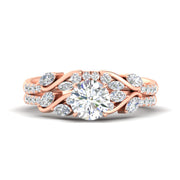
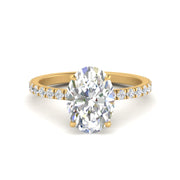
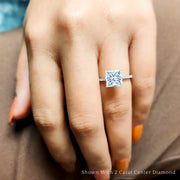
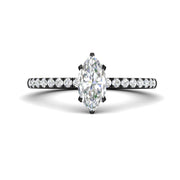
Pavé engagement rings set small diamonds closely along the band so that virtually no metal is visible between stones, creating a continuous surface of brilliance that extends the ring's sparkle from center stone to shank. Every ring in this collection is available with a diamond, sapphire, emerald, ruby, or black diamond center stone in natural or lab-grown, set in 14K or 18K white gold, yellow gold, rose gold, black gold, or platinum. Styles include French pavé, micro pavé, hidden halo, pavé split shank, rollover halo, twisted vine, swirl, antique filigree, and complete bridal sets. Prices start at $1,063. All rings are made in the USA with free shipping and easy financing.
Explore Pavé Engagement Ring Collection













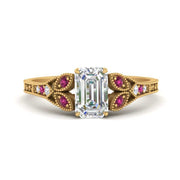






Real Customer Reviews
What Pavé Actually Means and Why It Matters
Pavé is a French word meaning "paved," and it describes exactly what the setting technique does: it tiles small diamonds across the surface of the band so closely together that the metal beneath them becomes nearly invisible. The result is a band that appears to be entirely composed of diamonds rather than metal set with diamonds. The visual effect is continuous, unbroken brilliance that runs alongside and often beneath the center stone, creating a ring that sparkles from every angle and in every light condition.
The mechanics of achieving this are precise and demanding. Each small stone in a pavé setting is secured by tiny beads of metal raised from the band surface itself, or in French pavé by small v-shaped cutouts in the metal that allow more light to pass through each stone from below. Getting the spacing, depth, and bead height consistent across dozens of individual stones requires skilled hand-setting. Quality differences in pavé execution are visible: well-executed pavé shows consistent stone size, uniform spacing, level setting heights, and minimal visible metal between stones. Poorly executed pavé shows irregular spacing, stones set at different heights, or excessive metal between stones that breaks the continuous brilliance effect.
At Fascinating Diamonds, all rings are handcrafted in the USA. The pavé settings across this collection are executed at a precision level that the price range and American craftsmanship standard support.
French Pavé vs. Micro Pavé vs. Standard Pavé
These three terms describe related but distinct pavé techniques, each with different visual characteristics and different structural considerations.
Standard pavé uses beads of metal raised from the band surface to hold each small diamond in place. The beads are visible between stones as tiny metal dots, which is characteristic of the technique. Standard pavé stones are typically in the 1.2 to 1.5 mm range. The bead structure makes this a secure and durable format that suits buyers who want strong stone retention.
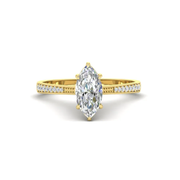
French pavé uses v-shaped or u-shaped cutouts in the metal between stones rather than surface-raised beads. Each stone sits within its own cutout, and the cutout shape allows light to enter the stone from below as well as from above. This produces more brilliance per stone than standard pavé, because the diamond receives light from multiple directions simultaneously. French pavé is more labor-intensive to execute than standard pavé and produces a lighter, more delicate visual. The French pavé princess cut cathedral ring, French pavé marquise ring, French pavé petite wedding ring set, and asscher cut French pavé wedding ring set in this collection all use this technique.
Micro pavé uses extremely small diamonds, typically 1.0 to 1.2 mm or smaller, set in precise tight rows with very small beads or prong retention. The resulting surface is extremely fine and delicate, almost like a diamond texture rather than individually visible stones. Micro pavé creates the highest visual density of diamond coverage per millimeter of band width, producing the most refined and detailed sparkle in the pavé category. It is also the most technically demanding to execute and requires the most careful maintenance over time.
Pavé Setting Styles in This Collection
French pavé solitaire bands pair a plain prong-set center stone with a French pavé-set band, so the brilliance of the band complements without competing with the center stone. The French pavé petite wedding ring set and French pavé round solitaire are the primary designs in this format.
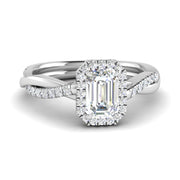
Pavé halo designs add a diamond halo around the center stone in addition to pavé along the band, creating maximum diamond coverage across the full face of the ring. The halo diamond wedding ring set, rollover halo nature-inspired ring, and halo emerald cut diamond ring with pavé twist all use this combination. The rollover halo is a specific design variant where the halo rolls over the girdle of the center stone rather than sitting flat around it, creating a three-dimensional diamond frame.
Hidden halo pavé rings place the pavé diamond ring below the center stone's girdle rather than at the same level as the table, so it is visible from the side and from the underside but not from the face-up view. The oval hidden halo engagement ring demonstrates this format: the center stone appears as a clean solitaire from above, but the hidden diamond halo becomes visible when the ring is tilted or observed from the side.
Pavé underhalo rings are similar to hidden halos but differ in that the diamond ring sits at the underside of the center stone mounting rather than strictly below the girdle. The asscher cut pavé underhalo ring uses this configuration, where the pavé diamonds circle beneath the asscher center and create brilliance from below.
Split shank pavé rings divide the band into two separate strands that diverge from the shank and converge at the center stone mounting, with pavé diamonds set along the full length of each strand. The split configuration gives the shank more dimensional visual interest than a single band and allows the center stone to appear more elevated and prominent. The pear lab grown twisted vine pavé wedding set uses a twisted split shank format where the two strands interlock as they approach the center.
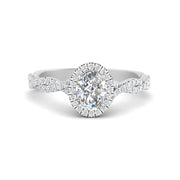
Twisted vine and organic pavé rings incorporate botanical or nature-inspired forms into the band metalwork alongside the pavé stones. The twisted vine luxury bridal set, round cut curved vine wedding ring set, and oval shaped pavé twist engagement ring all use this vocabulary, with vine-like twisting metal forms carrying pavé diamonds in an organic rather than geometric pattern.
Swirl pavé bridal sets use a curved swirl format in both the engagement ring and the matching band. The oval diamond swirl pavé wedding set and round swirl diamond wedding band set are the primary designs in this format. The swirl creates a flowing, curvilinear composition that pairs naturally with round and oval center stones.
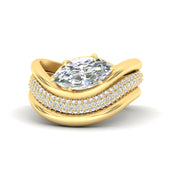
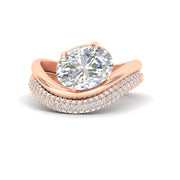
East-west pavé sets orient the center stone horizontally across the finger with a pavé-set band. The east-west oval wedding band ring set places an oval center in the horizontal orientation with a matching pavé band, creating a contemporary, fashion-forward combination.
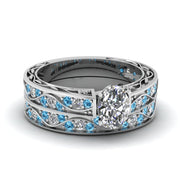
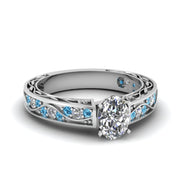
Antique filigree pavé rings combine pavé stones with hand-worked filigree metalwork, creating rings with the highest level of artisanal detail in the collection. The antique filigree engagement ring and antique filigree wedding ring set use intricate lace-like metalwork alongside the pavé stones, referencing Edwardian and Art Nouveau jewelry traditions.
Dual and wave band designs stack multiple pavé bands with a center solitaire. The dual bands with wave solitaire ring and the pavé band with wave solitaire ring both use this format, where the center solitaire is framed by one or two flanking pavé bands that create a stacked, layered composition as a single piece.
Daisy and nature-themed designs include the daisy twisted bridal ring set, which pairs a cushion-contour pavé band with a floral-motif engagement ring, and the rollover halo nature-inspired ring, which uses a cushion center with a rollover diamond halo and nature-inspired band detailing.
Pavé Bridal Sets in This Collection
More than a third of the designs in this collection are complete bridal sets, pairing an engagement ring with a coordinated matching wedding band as a single purchase. This is the largest proportion of bridal sets across any Fascinating Diamonds collection and reflects how naturally the pavé format lends itself to matched sets.
In a pavé bridal set, the engagement ring and wedding band are designed to sit flush together, with the band's pavé following the curve of the engagement ring's shank so that both rings read as a unified composition rather than two separate pieces. Gaps between mismatched ring profiles are eliminated because both pieces were designed for each other.
Available bridal sets in this collection include the round cut curved vine wedding ring set ($3,036), oval diamond swirl pavé wedding set ($1,819), east-west oval wedding band ring set ($1,842), antique filigree wedding ring set ($3,842), French pavé petite wedding ring set ($1,964), halo diamond wedding ring set ($2,004), asscher cut French pavé diamond wedding ring set ($2,101), pear lab grown twisted vine pavé wedding ring set ($2,337), daisy twisted bridal ring set ($2,149), twisted pear halo bridal ring set ($3,155), twisted vine luxury bridal set ($3,115), and dual bands with wave solitaire ring ($2,797).
Buying a bridal set guarantees ring profile compatibility, ensures a matching aesthetic language across both pieces, and is typically more economical than purchasing the engagement ring and band separately.
Pavé Settings and Stone Loss: What Buyers Should Know
Pavé engagement rings are among the highest-maintenance settings in fine jewelry. This is not a reason to avoid them, but it is information that should be understood before buying.
Each small diamond in a pavé setting is held by tiny beads or prongs rather than the larger, more robust prong structures that hold center stones. These small retention points can loosen with sustained wear, contact with hard surfaces, and the minor flexing that a ring band experiences through daily hand use. A loosened stone in a pavé setting can vibrate out of its seat and be lost without the wearer noticing, particularly because the stones are small and the gap left behind can be difficult to detect visually against the setting's overall texture.
Preventing stone loss in pavé settings requires two practices. First, avoid exposing the ring to hard impacts and abrasive surfaces that place stress on the small bead retentions. Removing the ring before gym sessions, manual labor, gardening, and similar activities reduces this risk significantly. Second, have the ring professionally inspected twice a year. A jeweler can identify loose stones before they fall out and retighten beads before they fail. Annual inspection is the minimum; twice yearly is the recommendation for pavé specifically.
Ultrasonic cleaning is generally safe for pavé settings and is effective for reaching between closely set stones. Avoid steam cleaning at high pressure, which can stress micro bead retention points. Routine hand cleaning with warm water, mild soap, and a soft brush is appropriate for weekly maintenance.
Center Stone and Gemstone Options
This collection accommodates the second broadest center stone range of any engagement ring category at Fascinating Diamonds, after the bezel collection. Center stone options include colorless diamond (natural and lab-grown), blue sapphire, pink sapphire, orange sapphire, green emerald, ruby, black diamond, blue topaz, and purple amethyst.
Pavé settings are particularly effective for colored center stones because the diamond band amplifies the center stone's visual presence through contrast. Diamonds surrounding a colored stone create a bright neutral border that makes the color read as more saturated. A blue sapphire in a pavé-set halo ring appears more vivid than the same sapphire in a plain solitaire setting because the surrounding diamonds create contrast that intensifies the hue.
Black diamond center stones with pavé-set white diamond bands create the maximum tonal contrast in this format: dark opaque center against bright surrounding diamonds. This combination is available with black gold shank options in several designs, where the dark metal extends the black diamond's monochrome aesthetic into the band itself while the pavé diamonds provide brilliance at the setting.
All gemstone center stones (sapphire, emerald, ruby, black diamond) are lab-grown. White diamond center stones are available in natural and lab-grown.
Metal Options Including Black Gold
All rings in this collection are available in 14K and 18K white gold, yellow gold, rose gold, and platinum. Black gold in 14K and 18K is available on 8 designs, making this one of two engagement ring collections at Fascinating Diamonds to offer black gold alongside the bezel collection.
White gold and platinum are the most widely chosen metals for pavé engagement rings. Both provide a cool, neutral surface that maximizes the visual impact of the pavé diamonds and provides clean contrast with colored center stones. Platinum is more durable, hypoallergenic, and does not require rhodium plating. White gold costs less but needs periodic replating.
Rose gold is the most popular current market choice for pavé rings. The warm pinkish-rose metal provides a romantic, contemporary background for the diamond pavé, and the contrast between warm metal and white diamond sparkle creates a soft warmth that white gold does not. Rose gold pavé rings are among the most searched engagement ring aesthetics across social media and bridal planning platforms.
Yellow gold creates warm, traditional contrast with both diamond and gemstone center stones. Yellow gold pavé rings reference the aesthetic of Art Nouveau and Edwardian jewelry where pavé detailing in gold was a primary design language.
Black gold creates a fully tonal monochrome pairing when used with black diamond center stones, or bold high-contrast pairing with white diamond or sapphire centers where the dark metal makes the diamonds and center stone read as brighter by opposition.
Pavé vs. Channel Setting: Understanding the Difference
Buyers comparing pavé and channel settings frequently ask how the two differ. The distinction is mechanical and visual.
In a channel setting, diamonds are set within a groove between two raised metal walls. The stones sit in a continuous row with their girdles protected inside the channel. The result is a flat, smooth surface across the top of the band with no visible prongs or beads between stones.
In a pavé setting, diamonds sit on the surface of the band secured by small metal beads or prong cutouts. The stones project slightly above the band surface rather than sitting within it. The result is a textured, dimensional surface with visible sparkle depth.
Channel settings are more protective and lower maintenance. Pavé settings produce more brilliance per millimeter because each stone is more fully exposed to light from multiple directions. The choice between them is one of maintenance preference and visual priority. Several designs in this collection combine both techniques, with channel-set stones on the band sides and pavé on the top face for a format that balances protection and brilliance.
FAQs For Pavé Engagement Rings
1. What is a pavé engagement ring?
A pavé engagement ring features small diamonds set closely along the band with minimal metal visible between stones, creating a continuous surface of brilliance. The technique takes its name from the French word for "paved."
2. What is the difference between French pavé, micro pavé, and standard pavé?
Standard pavé uses raised metal beads to hold each stone. French pavé uses v-shaped cutouts in the metal between stones for more light entry and more brilliance per stone. Micro pavé uses extremely small diamonds in very tight rows for the finest, most delicate sparkle. French pavé is the most brilliant; micro pavé is the most refined; standard pavé is the most durable.
3. Are pavé engagement rings prone to stone loss?
More so than prong-set solitaires. The small bead or prong retentions that hold pavé stones can loosen with sustained wear. Professional inspection twice a year and avoiding impact activities while wearing the ring significantly reduce this risk.
4. What is a hidden halo pavé ring?
A hidden halo places the diamond ring beneath the center stone's girdle rather than at the same plane as the table. From above, the ring looks like a clean solitaire. From the side, the surrounding diamond halo becomes visible, adding brilliance and perceived size without the traditional halo's visible frame from above.
5. Are pavé engagement rings available with gemstone center stones?
Yes. This collection offers pavé rings with blue sapphire, pink sapphire, orange sapphire, green emerald, ruby, black diamond, blue topaz, and purple amethyst center stones in addition to colorless diamond. All gemstone center stones are lab-grown.
6. What is a pavé bridal set?
A pavé bridal set pairs a pavé engagement ring with a coordinated matching wedding band designed to sit flush against it. The two pieces are designed together, eliminating profile-gap issues and ensuring visual continuity. This collection includes more than 12 bridal set designs.
7. How do I care for a pavé engagement ring?
Clean weekly with warm water, mild soap, and a soft brush. Have the ring professionally inspected twice a year to check for loose stones. Remove before gym sessions, manual labor, and impact activities. Ultrasonic cleaning is generally safe for pavé settings.
8. What metals are available for pavé engagement rings at Fascinating Diamonds?
All rings are available in 14K and 18K white gold, yellow gold, rose gold, and platinum. Black gold in 14K and 18K is available on select designs.
9. What is the difference between pavé and channel settings?
Channel settings embed diamonds within a groove between two metal walls, creating a smooth, flat band surface. Pavé settings secure diamonds on the band surface with small beads or prong cutouts, creating a dimensional, sparkle-textured surface. Channel settings are lower maintenance; pavé settings produce more brilliance.
10. What is the price range for pavé engagement rings at Fascinating Diamonds?
Prices start at $1,063 for the French pavé princess cut cathedral ring and reach $22,887 across 37 designs, including complete bridal sets, in all center stone, carat weight, and metal options.