

Channel Set Engagement Rings
Channel set engagement rings secure diamonds between two continuous metal walls with no exposed prongs, creating the most snag-free, low-maintenance setting format available for an engagement ring worn every day. Every ring in this collection is available with a diamond, sapphire, emerald, ruby, or black diamond center stone in natural or lab-grown, set in 14K or 18K white gold, yellow gold, rose gold, black gold, or platinum. Styles include three-stone channel, bar channel, swirl halo with baguette channel band, Celtic two-tone, graduated channel, and trapezoid side stone designs. Prices start at $1,810. All rings are made in the USA with free shipping and easy financing.
Explore our Channel Set Engagement Rings Collections







Real Customer Reviews
How a Channel Setting Works and Why It Matters for Everyday Wear
A channel setting secures diamonds by embedding them within a groove cut into the metal of the ring band, with two raised metal walls running along either side of the stone row. The diamonds sit within this groove with their tables flush with or slightly above the metal surface. No individual prongs hold each stone. No bead tips project above the surface. The result is a band that is smooth, continuous, and essentially flat across its set surface.
This mechanical difference from prong and pavé settings has direct practical consequences. In a prong setting, individual metal claws grip each stone above the band surface. These prongs catch on fabric, hair, and surfaces throughout the day. Over time, catching events bend prong tips and loosen stones. In a channel setting, there are no projecting elements to catch. The surface of the band moves through contact with the world without snagging because there is nothing to snag. Channel settings do not require the same frequency of professional inspection that pavé settings demand, because the retention mechanism is the metal wall itself rather than small individual bead points.
For buyers who wear their engagement ring continuously through work, exercise, and daily activity, the channel setting is the most practical high-diamond-coverage format available. It is not the setting with the maximum light exposure per stone, that honor belongs to prong settings. But it is the setting where the diamonds will remain secure and the ring will remain comfortable through the widest range of daily activities over the longest period of time.
Channel Setting Variants in This Collection
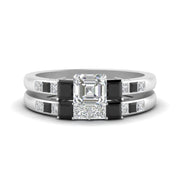
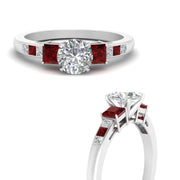
Classic channel three-stone designs place the center stone flanked by two channel-set side stones of similar or coordinating shape. The round cut channel three-stone classic ring ($2,156) uses round side stones in individual channel mounts flanking the center. The 3-stone channel accent wedding set ($4,068) uses asscher-cut side stones in channel settings alongside a larger center, with black diamond or sapphire side stone options creating strong color contrast. Three-stone channel rings are among the most symbolically loaded designs available, combining the past-present-future meaning of the three-stone format with the security and clean profile of the channel setting.
Bar channel designs set diamonds in a continuous horizontal bar across the shank, with the channel running perpendicular to the band's length rather than along it. The princess cut channel bar set diamond engagement ring ($1,996) uses princess-cut side diamonds in this format, and the channel bar diamond wedding ring set ($4,015) extends this to a complete bridal set with a matching channel bar band. Bar channel settings create a graphic, architectural composition that suits princess and square-cut stones particularly well, as the stone's straight edges align naturally with the channel's straight walls.
Swirl channel designs incorporate curved metalwork alongside the channel-set diamonds, creating a more fluid, dynamic composition than straight channel formats. The swirl channel engagement ring ($2,461) uses an asscher center with a swirling channel-set diamond shank that curves around the center mount. The swirl channel bridal set ($3,646) extends this to a complete bridal set with a coordinated channel-set band. The swirl halo big engagement ring ($3,255) and swirl halo bridal ring set ($4,089) combine a diamond halo at the center with baguette-cut diamonds channel-set in a sweeping swirl band, creating the most visually complex designs in the collection.
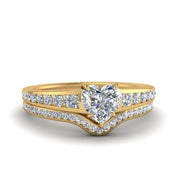
Graduated channel designs vary the size of channel-set stones along the shank, with larger diamonds at the center tapering to smaller ones toward the sides. The graduated channel wedding set ($2,709) uses a heart-cut center with graduated channel-set side diamonds and a coordinated band. The graduated channel accented ring ($1,810) pairs a pear-shaped center with a swirl-engraved shank and graduated channel accents. Graduated channel rings create natural visual movement along the band that draws the eye toward the center stone.
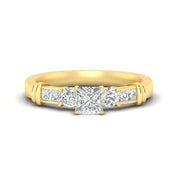
Trapezoid side stone channel designs use trapezoid-shaped side diamonds set in channel mounts that taper along the shank toward the center stone. The princess cut trapezoid lab diamond engagement ring ($3,195) is the primary design in this format. Trapezoid side stones are cut to follow the taper of the shank, creating a seamless linear progression from band to center stone that makes the center appear larger and more elevated. This is the most architecturally precise design format in the collection.
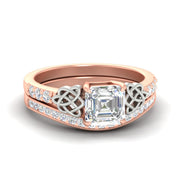
Celtic two-tone channel designs combine Celtic interlaced metalwork with channel-set diamonds in a two-tone metal construction. The channel band Celtic two-tone asscher bridal set ($2,333) pairs an asscher center stone with a Celtic knot-inspired shank in rose and white gold two-tone metal, with channel-set diamonds along the band. This is the most historically referential design in the collection and suits buyers who want both structural security and ornamental metalwork in the same ring.
Channel Setting vs. Pavé vs. Prong: A Direct Comparison
The three dominant setting techniques for accent diamonds in engagement rings each make different tradeoffs between light performance, security, and maintenance. Understanding these tradeoffs precisely helps in selecting the right setting for a specific lifestyle and aesthetic.
Prong settings secure each stone with individual metal claws that grip the girdle above the band surface. This allows maximum light entry into each stone from multiple directions and produces the highest brilliance per stone of any setting type. The tradeoff is exposure: prong tips project above the surface and catch on fabric and other materials. Prongs bend and loosen with sustained wear and require periodic professional tightening. Prong settings suit buyers who prioritize diamond brilliance and are comfortable with more frequent professional maintenance.
Pavé settings secure small stones with tiny metal beads or v-shaped cutouts close to the surface. The diamonds are more exposed to light than in a channel setting and produce more brilliance than channel-set stones of equal size. The small bead retentions are more vulnerable than channel walls and can loosen with sustained wear. Pavé settings require more maintenance than channel settings and suit buyers who prioritize maximum sparkle over maintenance convenience.
Channel settings secure stones within a metal groove with no projecting retention points above the surface. The metal walls protect stone girdles on both sides. Light enters each stone primarily from above through the table, with less side entry than prong or pavé settings. The result is a different quality of sparkle rather than a lesser one: channel-set diamonds produce a cleaner, more contained brilliance rather than the scintillating, directional flash of prong-set stones. Channel settings require the least maintenance of the three and suit buyers who prioritize durability and snag-free wear.
Neither setting is objectively superior. The channel is the right choice when daily practicality and low maintenance are the primary decision criteria. The pavé is the right choice when maximum sparkle across the band is the priority. The prong is the right choice when individual stone light performance matters above all other factors.
Diamond Shapes That Work Best in Channel Settings
Not all diamond shapes perform equally well in channel settings. The mechanical requirements of the channel, two parallel straight walls that must grip the stone at consistent points along its girdle, favor certain shapes over others.
Princess cut (square) diamonds are the best natural fit for channel settings. The square outline aligns precisely with the straight channel walls, the stone's flat sides sit flush against the metal, and the corners are protected within the channel groove. The princess cut channel bar design in this collection demonstrates this compatibility directly.
Round cut diamonds are the most common channel-set shape overall because of their visual versatility. The curved girdle requires the channel walls to grip at the stone's widest equatorial plane rather than along a flat edge, which is achievable in precision-cut channels. Round channel-set stones produce a continuous line of curved faces along the shank that reads as soft and traditional.
Baguette cut (rectangular step-cut) diamonds suit channel settings very well. Their straight sides align naturally with channel walls. The step-cut faceting pattern produces a clean, graphic brilliance that differs from brilliant-cut sparkle. The swirl halo designs in this collection use baguette-cut channel-set bands to create a contrast between the baguette's linear geometry and the round center stone's brilliance.
Trapezoid cut diamonds are channel-set in tapered mounts that follow the ring shank's taper. This requires precision cutting of both the stone and the channel, as the trapezoid's angled sides must match the shank's angle exactly. The trapezoid ring in this collection demonstrates this precision in its seamless linear progression from band to center.
Asscher cut (square step-cut) diamonds suit channel settings for the same reasons as princess cuts, with the additional visual quality of the asscher's distinctive square outline and stepped faceting. The Celtic bridal set and swirl channel ring in this collection both use asscher centers with channel-set accent bands.
Center Stone and Gemstone Options
This collection accommodates a broad center stone range: colorless diamond (natural and lab-grown), blue sapphire, pink sapphire, orange sapphire, green emerald, ruby, black diamond, blue topaz, and purple amethyst. Center stone options vary by specific design, with 9 designs accommodating blue sapphire, pink sapphire, ruby, and black diamond, and 7 designs accommodating green emerald and orange sapphire.
The channel setting is particularly effective for gemstone center stones because the smooth, prong-free band profile focuses visual attention directly on the center stone without competition from complex side stone settings. A blue sapphire in a channel-set three-stone ring with diamond side stones reads as a clean, direct statement: vivid color center, secure setting, nothing extraneous in the design.
For the three-stone channel designs specifically, gemstone center and diamond side stone combinations are among the most visually compelling configurations. The black diamond variant of the 3-stone channel accent wedding set creates a strong tonal opposition between the black diamond sides and a colorless or sapphire center. Sapphire centers with diamond side stones in the three-stone classic ring create the color-plus-brilliance contrast that is one of the most effective combinations in fine jewelry.
All gemstone center stones are lab-grown. White diamond center stones are available in both natural and lab-grown.
Channel Setting and Resizing
Channel set engagement rings can be resized, but the process has a specific limitation that buyers should understand before purchase.
Standard ring resizing involves removing a section of the band and rejoining it at a smaller diameter, or adding metal to increase the diameter. For plain metal shanks, this is straightforward. For channel-set shanks, the channel runs continuously along the band and contains diamonds. Resizing disrupts this continuity. A skilled jeweler can resize a channel-set ring by one to two sizes in most cases by working from a section of the band that does not carry channel-set stones. Beyond that range, resizing becomes impractical without removing stones and resetting them.
This means accurate ring sizing at purchase is more important for channel-set engagement rings than for prong-set solitaires. Rings can typically be sized down by one size or up by one to two sizes without structural compromise. Larger adjustments require more involved work and should be discussed with a jeweler before attempting.
For the bridal set designs in this collection, where the engagement ring and wedding band are purchased together, both rings should be sized to the same finger measurement at the time of purchase to ensure they sit correctly together after both are worn simultaneously.
Metal Options Including Black Gold
All rings in this collection are available in 14K and 18K white gold, yellow gold, rose gold, and platinum. Black gold in 14K and 18K is available on three designs.
White gold and platinum are the most widely chosen metals for channel set engagement rings. Both provide a neutral background that maximizes the visual impact of the channel-set accent diamonds and provides clean contrast with colored center stones. Platinum is more durable, hypoallergenic, and requires no rhodium plating over time.
Rose gold is the most popular current choice for channel set rings with sapphire or ruby center stones. The warm metal creates a romantic contrast with blue sapphire and tonal harmony with ruby. The Celtic two-tone bridal set uses rose and white gold together, the only two-tone metal design in this collection.
Yellow gold suits designs with warmer center stones, particularly orange sapphire, ruby, and emerald, where the warm metal amplifies the stone's own warmth rather than contrasting with it.
Black gold creates a fully tonal composition when paired with black diamond center stones, or high-contrast drama with colorless diamond centers. Three designs in this collection are available in black gold configurations.
Channel Set Engagement Ring Care
Channel set engagement rings are the lowest-maintenance high-diamond-coverage format among the three primary setting types. The enclosed channel walls protect stone girdles from impact and the smooth surface eliminates the prong-catching failure mode that requires frequent attention in pavé and prong settings.
Clean with warm water, mild dish soap, and a soft-bristle brush. Work along the channel surface, paying particular attention to the underside of the channel where skin oils and debris accumulate between the metal walls and the stone bases. Rinse thoroughly and dry with a lint-free cloth.
Ultrasonic cleaning is safe for channel set diamond rings. For rings with gemstone center stones, the gemstone determines the cleaning method: sapphire and ruby centers are safe for ultrasonic cleaning; emerald centers are not, as ultrasonic vibration can stress emerald's natural cleavage planes. Clean emerald-center channel rings manually only.
Professional inspection once a year is the appropriate maintenance schedule for channel set rings. During inspection, a jeweler checks that the channel walls remain tight against the stone girdles and that no stones have shifted within the channel. While channel settings fail less frequently than pavé settings, the enclosed nature of the channel means that a stone that has loosened is not always visible without close inspection.
FAQs For Channel Set Engagement Rings
1. What is a channel set engagement ring?
A channel set ring secures diamonds within a groove between two raised metal walls with no individual prongs. The stones sit within the groove with their girdles protected by the metal walls on both sides, creating a smooth, continuous setting surface.
2. Are channel set engagement rings durable for everyday wear?
Yes. Channel settings are among the most durable high-diamond-coverage engagement ring formats. The protected channel walls eliminate the prong-catching failure mode and protect stone girdles from direct impact. They are the recommended setting for buyers with physically active lifestyles or hands-on professions.
3. Do channel set diamonds sparkle less than prong-set diamonds?
Channel-set diamonds receive less light from the sides than prong-set stones, producing a different quality of sparkle rather than a lesser one. The brilliance is clean and contained rather than directional and scintillating. For buyers who want maximum light performance from accent stones, prong or pavé settings produce more brilliance. For buyers who prioritize durability and clean aesthetics, channel settings deliver excellent brilliance with better stone security.
4. Can channel set engagement rings be resized?
Yes, within a range of approximately one to two sizes in either direction. The continuous channel limits how much material can be added or removed without disrupting the stone setting. Accurate sizing at purchase is more important for channel rings than for simple solitaires.
5. What diamond shapes work best in channel settings?
Princess, round, baguette, asscher, and trapezoid cuts are the most common and most effective shapes for channel settings. Princess and baguette cuts are particularly well-suited because their straight sides align naturally with the channel walls.
6. Are channel set rings available with gemstone center stones?
Yes. This collection offers channel rings with blue sapphire, pink sapphire, orange sapphire, green emerald, ruby, and black diamond center stones in addition to colorless diamond. All gemstone center stones are lab-grown.
7. What is the difference between a channel set and a bar set ring?
A channel set runs diamonds continuously within a groove along the shank. A bar set places diamonds in a horizontal bar perpendicular to the shank, with the stones set between two vertical metal walls that create a distinct band element. The channel bar designs in this collection combine both elements.
8. Are lab grown diamonds available in channel set engagement rings?
Yes. Both natural and lab grown diamond center stones are available across this collection. Channel-set accent diamonds are also available in both natural and lab grown options.
9. What metals are available for channel set engagement rings at Fascinating Diamonds?
All rings are available in 14K and 18K white gold, yellow gold, rose gold, and platinum. Black gold in 14K and 18K is available on select designs.
10. What is the price range for channel set engagement rings at Fascinating Diamonds?
Prices start at $1,810 for the graduated channel accented ring and reach $6,709 across 12 designs in three-stone, bar, swirl, graduated, trapezoid, Celtic, and swirl halo formats across all center stone and metal options.