


What Is a Diamond Carat?
A diamond carat is the unit used to measure a diamond’s weight. One carat equals 200 milligrams, or 0.2 grams. Carat is one of the 4Cs, along with diamond cut, diamond color, and diamond clarity. It is the only one of the four that is measured on a scale.
Carat measures weight, not size. A diamond’s weight and its visible size are related, but they aren’t the same thing. Cut, shape, and proportions decide how large a stone looks from above.
The word “carat” comes from the carob seed, which traders once used as a counterweight on balance scales. The metric carat of 200 milligrams became the international standard in the early 1900s.
How Diamond Carats Are Divided
Each carat is divided into 100 units called points. This matters for smaller stones and for reading a grading report
| Weight in points | Weight in carats |
|---|---|
| 25 points | 0.25 ct |
| 50 points | 0.50 ct |
| 75 points | 0.75 ct |
| 100 points | 1.00 ct |

Diamonds Total Carat Weight
Total carat weight, or TCW, is the combined weight of every diamond in a piece. It applies to halo rings, three-stone rings, eternity bands, and tennis bracelets.
A halo ring with a 1.00 ct center stone and 0.30 ct of accent diamonds has a TCW of 1.30 ct. The center stone is still 1.00 ct. When you compare two rings, check whether the listed carat is the center stone weight or the TCW. Browse halo engagement rings and three-stone engagement rings to see how accent stones add to TCW.
Diamond Carat Size Chart
This chart shows the approximate face-up diameter of a round brilliant diamond at each carat weight. Measurements vary slightly with cut proportions.
| Carat weight | Approx. diameter |
|---|---|
| 0.25 ct | 4.1 mm |
| 0.50 ct | 5.1 mm |
| 0.75 ct | 5.8 mm |
| 1.00 ct | 1.00 ct |
| 1.50 ct | 7.4 mm |
| 2.00 ct | 8.2 mm |
| 3.00 ct | 9.4 mm |
Doubling the weight doesn’t double the diameter. A 2.00 ct round is only about 1.7 mm wider than a 1.00 ct round. This is because a diamond’s weight grows with its volume, while the eye reads the face-up surface.
Engagement Ring Carat Weights
-

Marquise Cut Lab Diamond Hidden Halo 1 Carat Diamond Ring
$2,106.80Shop Now -

East West Cushion 2 Tone 1 CT Diamond Ring
$1,753.75Shop Now -

Asscher Cut Lab Grown Twisted Vine 1 Carat Diamond Ring
$1,972.25Shop Now -

Cushion Cut Halo Eternity One Carat Diamond Engagement Ring
$2,098.75Shop Now -
SAVE 37%

Lab Grown Round Cut Curved Vine 1.00 Carat Diamond Ring
$1,406.45$2,224.10Shop Now -

Pear Accented Cluster 1 Carat Diamond Ring
$1,697.40Shop Now -

Marquise Cut Twisted Shank One Carat Diamond Engagement Ring
$1,805.50Shop Now -

Marquise Cut Twisted Shank 1.00 Carat Diamond Ring
$1,736.50Shop Now


-

Emerald Cut Vine Hidden Halo 2 Carat Diamond Ring
$2,512.75Shop Now -

East West Oval Solitaire Two Carat Diamond Ring
$2,035.50Shop Now -

Emerald Cut 2CT Diamond Wedding Ring
$3,427.00Shop Now -

Oval Floral Vintage Lab 2 Carat Diamond Ring
$2,651.90Shop Now -

Petite Swirl Round Two Carat Diamond Ring
$23,908.50Shop Now -

Asscher Cut Pavé Halo 2CT Diamond Wedding Ring
$2,523.10Shop Now -

East West Oval Bezel 2 Carat Diamond Ring
$3,098.10Shop Now -

Delicate Vine Two Carat Diamond Ring
$2,530.00Shop Now


-
SAVE 37%

Lab Grown Round Cut Curved Vine 3 Carat Diamond Ring
$2,067.70$3,270.60Shop Now -

Halo Swirl Lab-Grown Round Three Carat Diamond Ring
$3,175.15Shop Now -

Asscher Cut Lab Grown 3.00 CT Diamond Ring
$2,900.30Shop Now -

Oval Half Bezel Three Carat Diamond Ring
$2,635.80Shop Now -

Marquise Cut Curved Pavé Lab 3.00 CT Diamond Ring
$3,584.55Shop Now -

Bypass Round Cut Solitaire 3.00 CT Diamond Ring
$2,654.20Shop Now -

Bypass Round Cut Solitaire Diamond Engagement Ring
$2,595.55Shop Now


-

Lab Grown Oval Hidden Halo 4 Carat Diamond Ring
$3,284.40Shop Now -

Bypass Twist Marquise Cut Solitaire Four Carat Diamond Ring
$3,924.95Shop Now -

Curved Vine Scalloped Lab Round 4.0 Carat Diamond Ring
$3,859.40Shop Now -

Asscher Cut Celtic Two Tone Lab Grown 4 Carat Diamond Ring
$3,492.55Shop Now -

Hidden Halo Micropave Four Carat Diamond Ring
$3,596.05Shop Now -

Pear Accented 3 Row Asscher Cut 4.0 Carat Diamond Ring
$3,566.15Shop Now -

Asscher Cut Thin Baguette 4 Carat Diamond Ring
$3,851.35Shop Now -

Asscher Cut Lab Diamond Trapezoid Side Four Carat Diamond Ring
$5,288.85Shop Now


-
SAVE 37%
Lab Grown Round Cut Curved Vine 5 Carat Diamond Ring
$2,728.95$4,317.10Shop Now -

Oval Offbeat Modern Five Carat Diamond Ring
$3,569.60Shop Now -
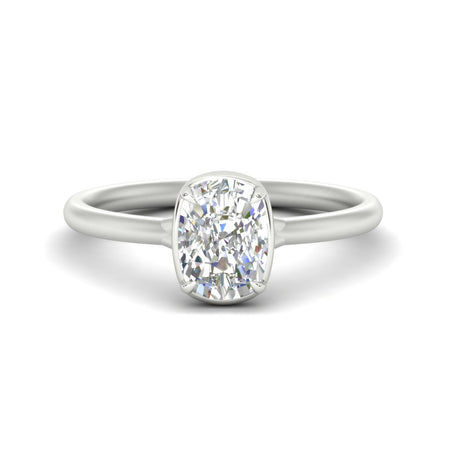
Cushion Cut Flush Collet Solitaire 5 CT Diamond Engagement Ring
$3,642.05Shop Now -

Twisted Vine Floral 5 Carat Diamond Ring
$4,004.30Shop Now -

Lab Grown Round Diamond Split Shank Five Carat Ring
$5,968.50Shop Now -

Heart Shaped Diamond Bar Set 5 CT Diamond Engagement Ring
$4,042.25Shop Now


Why Shape Changes How Big a Carat Looks
Two diamonds of the same carat weight can look very different on the hand. Shape decides how much of the weight shows on the surface and how much sits below it in depth.
Shapes that look larger for their weight:
- Oval, marquise, and pear have elongated outlines that spread across the finger.
- Emerald and radiant cuts have wide, shallow tables.
Shapes that look smaller for their weight:
- Princess, cushion, and Asscher cuts hold more weight in depth.
- Round brilliant diamonds are deeper than many fancy shapes, so they have a smaller face-up spread per carat.
Explore our diamond shapes guide to compare outlines, or shop oval diamonds and marquise diamonds for shapes that maximize face-up size.

How Carat Affects Diamond Price
Price per carat rises as weight increases, so a 2.00 ct diamond costs much more than twice a 1.00 ct diamond of the same quality. Larger rough crystals are rarer, and larger finished stones are in higher demand.
Prices also jump at certain weights. Buyers search for round numbers like 0.50, 1.00, and 2.00 carats, so a stone just under a round weight is priced noticeably lower.
Practical tip: A 0.90 ct or 0.95 ct diamond often looks nearly identical to a 1.00 ct stone, but it can cost less. Check the diameter in millimeters, not only the carat weight.

Carat and the Other 4Cs
Carat works best when you balance it against the other three Cs.
- Cut: A well-cut diamond looks larger and brighter than a poorly cut stone of the same weight. A deep or shallow cut hides weight in the wrong places.
- Color: Tint becomes easier to see as carat weight increases. A 3.00 ct stone shows color more than a 0.50 ct stone of the same grade.
- Clarity: Inclusions are easier to spot in larger stones, especially in step cuts like emerald and Asscher.
If the budget is fixed, many buyers choose a slightly smaller carat weight with a stronger cut grade. This usually gives a brighter, more balanced diamond.

Carat Weight for Natural and Lab-Grown Diamonds
Carat is measured the same way for natural and lab-grown diamonds. A 1.00 ct lab-grown diamond and a 1.00 ct natural diamond have the same weight and the same face-up size when the cut and shape match. Both are real diamonds with the same chemical makeup and physical properties.
The main difference is price. Lab-grown diamonds usually cost less per carat, which lets many buyers choose a larger stone within the same budget. Browse lab-grown diamonds and natural diamonds to compare options by weight.
Real Customer Reviews
Frequently Asked Questions
Is a bigger carat always better?
A larger carat looks bigger but doesn’t always sparkle more. Cut quality impacts brilliance more than weight.
What’s the average carat for an engagement ring?
In the U.S., it’s about 1.0 carat. Globally, averages range from 0.50–0.90 carats.
Can two 1-carat diamonds look different?
Yes, depending on cut, shape, and dimensions.
How do I save money on carat?
Choose just under milestone weights (e.g., 0.90 ct), and prioritize cut for maximum sparkle.